
1
Container shape
Round containers need stable rotation. Diameter, height, taper, surface finish and product stability all affect label placement.
Vial and small bottle labelling
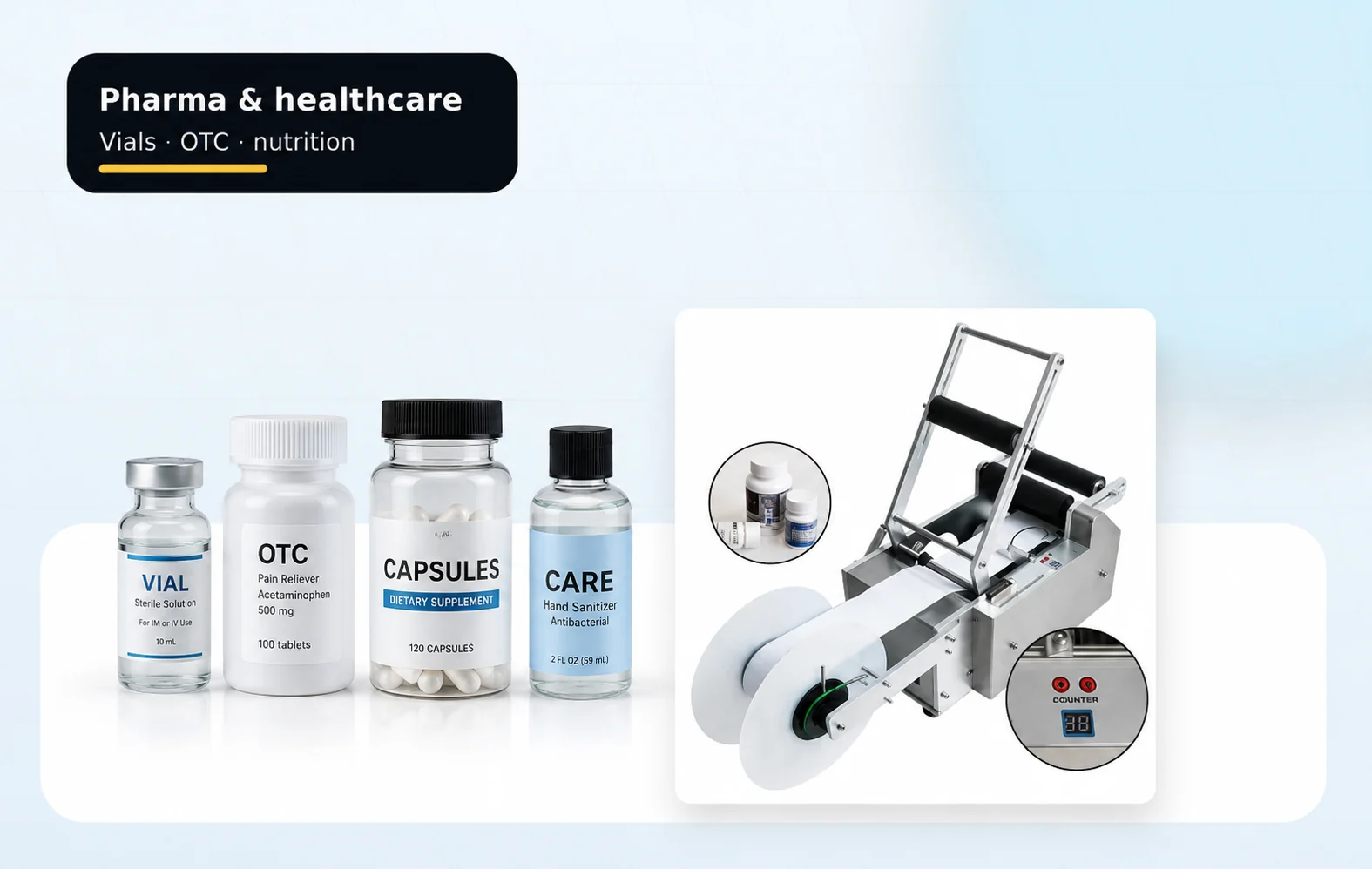
Vial labelling machines and small bottle labellers for healthcare, laboratory, cosmetic and small cylindrical containers.
Buyer guide
For better results, the machine should be selected around real containers, labels and output targets rather than by catalogue title alone.
Round containers need stable rotation. Diameter, height, taper, surface finish and product stability all affect label placement.
Paper, film and transparent labels may require different sensors and setup. Clear labels normally need a suitable clear-label sensor.
Semi-automatic systems suit small batches. Compact and fully automatic machines suit regular production and line integration.
Applications
Food, drink, cosmetics, healthcare, chemical and personal care bottles with cylindrical bodies.
Round containers where consistent product rotation allows a neat wraparound label seam.
Automatic systems can be considered with conveyors, spacing wheels, sensors, coding and production line controls.
Related searches
For inline and higher-output bottle labelling applications.
For smaller production runs and operator-fed applications.
For bottles, jars, cans and cylindrical packs.
Quick enquiry
Include the container diameter, label size, material, target output and whether the label is paper, film or transparent.
Phone: 01494 623015
Email: sales@lancinguk.com
Small-container engineering
A small diameter gives less contact area and makes a minor height or skew change more visible across the finished wrap.
Check that the vial remains upright and rotates without slipping, rocking or contacting the cap or shoulder. Filled weight and base geometry can change the result.
Provide final label and web dimensions, gap, liner, core and winding direction. A stiff material or narrow web may peel and track differently from a larger bottle label.
Test transparent or low-contrast labels with the proposed sensor. Define the code area and inspect readability after the label has wrapped around the small diameter.
Agree a placement method using a consistent vial reference and measure a consecutive sample set. Inspect the seam, edge lift and any bubble where the label crosses a moulding seam. If orientation to a cap or container feature is required, state that separately because a basic wrap cycle does not necessarily register an unorientated vial.
The machine route depends on batch size and handling. Operator-fed work may suit a semi-automatic labeller, while regular or inline production may require automatic feeding and additional inspection. No pharmaceutical compliance or validation status is implied by the mechanical application alone; use the healthcare guide to define project boundaries.
For vials and small cylindrical bottles, identify the usable label panel between the base and shoulder. Show the closure and any projection that affects the way the container can be held or rotated. Provide both an unlabelled sample and the intended finished label arrangement.
State whether vials arrive upright, in trays or through another controlled presentation. Ask the proposal to explain how they enter the labelling step and how labelled units are collected. A trial on an individually placed sample should be distinguished from a demonstration of the planned production feed.
No. Supply the specific documentation, inspection and qualification requirements for the project and ask what the offered system includes. A machine category or successful label application does not establish compliance with an unstated validation standard.