
✓
Durable labels
Material and adhesive must suit the product environment.
Chemicals and lubricants
Chemical, detergent and lubricant products can place extra demands on labels and machinery. This guide covers practical points for labelling bottles and containers used for cleaners, oils, fluids and industrial products.
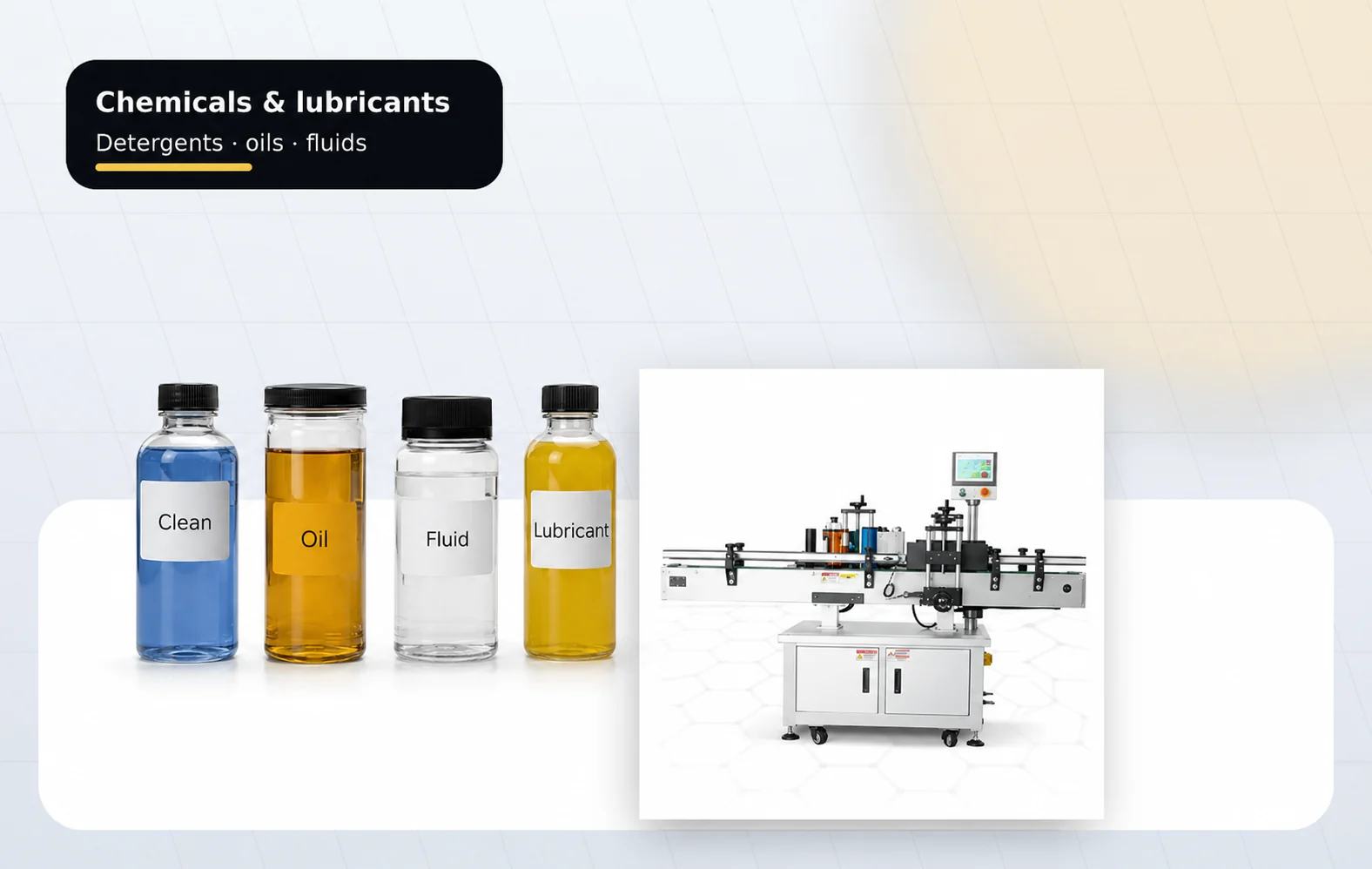
Industry guide
Chemical and lubricant labelling often needs durable labels, accurate placement and reliable adhesion despite challenging product residues or container materials. Safety and compliance information must remain readable, so repeatable label positioning matters.
Material and adhesive must suit the product environment.
Oil or chemical residue on the bottle can affect label adhesion.
Large or flexible bottles need correct guiding and support.
Practical comparison
| Product type | Container consideration | Labelling note |
|---|---|---|
| Lubricant oil | Plastic or metal bottle | Residue control is important |
| Cleaner | HDPE bottle | Label adhesive compatibility |
| Solvent product | Material and environment review | May need special project review |
| Detergent | Large or shaped bottle | Stability and guiding |
| Fluid sample | Small bottle or vial | Accurate small-label handling |
Specification advice
Review the actual container shape, diameter, label panel and surface finish. A label applicator works best when the pack is stable and the label area is predictable.
Confirm label material, roll direction, label gap and adhesive before ordering production labels. Clear, film or metallic labels may need extra testing.
Decide whether the operation is batch-fed, compact automatic or part of a conveyorised filling and capping line. The best machine is the one that fits the full process.
Related guidance
Use these guides to compare machine routes, confirm the label and container specification, and prepare the evidence needed for a useful quotation.
Browse selection, setup, sensing, output, integration and troubleshooting guidance for round-container labelling projects.
Compare bench, compact and automatic routes using container, label, output, changeover and integration requirements.
Collect container dimensions, label-roll data, output, coding and site details before requesting a machine quotation.
Check unwind direction, leading edge and roll presentation before ordering production labels or arranging a trial.
Measure the usable cylindrical panel and estimate label length, seam gap or overlap for a representative sample.
Separate headline cycle rate from sustainable accepted output by allowing for handling, coding, stops and changeovers.
Work through container, roll, sensor, guide and wrap settings when labels skew, wrinkle, bubble or fail to dispense.
Browse selection, setup, sensing, output, integration and troubleshooting guidance for round-container labelling projects.
Review conveyorised wraparound labelling for higher-output round-container lines and upstream or downstream integration.
Review a smaller automatic route for growing production where repeatability is needed without a full-size inline system.
Review operator-fed wraparound labelling for shorter batches, frequent changeovers and limited production space.
Compare bench, semi-automatic, compact and fully automatic wraparound labellers in one range overview.
Questions
They can be labelled if the label panel is clean and the label adhesive suits the surface.
Durability depends on label material, adhesive and exposure conditions.
Some products or environments need specific review before machinery is specified.
Technical review
This guide is maintained by Lancing's packaging machinery team. Lancing states that it has specialised in semi-automatic and fully automatic machinery for over 40 years and supports equipment across the UK, Europe and worldwide. Final recommendations are confirmed against actual containers, labels and production targets.
Last technical review: 11 July 2026 · About Lancing · Official company profile
Quick enquiry
Include container diameter, label size, material, target output and whether the label is paper, film or transparent. Lancing can recommend a suitable semi-automatic, compact or automatic configuration.
Phone: 01494 623015
Email: sales@lancinguk.com
Application review
Container rigidity, surface condition and label construction can vary more than the industry description suggests.
Include any oil, dust, mould-release residue, moisture or temperature that is present in normal production. A clean dry trial bottle may overstate adhesion compared with the production pack.
Check filled weight, wall flex, roundness, handle or shoulder features and whether the base remains stable through guides and wrap contact.
Provide the intended label face, liner and adhesive plus the hazard, batch or barcode area that must remain legible. Coding and verification requirements should be defined separately.
This guide addresses mechanical wraparound application only. Label durability, chemical resistance, hazard communication and regulatory content must be specified for the actual product, container, market and storage conditions; no general machinery page establishes compliance. Use first-party material data and the responsible compliance review for those decisions.
Trial filled or realistically weighted samples and inspect placement, seam, wrinkles, bubbles and edge lift immediately and after an agreed settling period. If containers arrive from filling with residue, reproduce that condition safely during the assessment. Compare the semi-automatic, compact automatic and fully automatic routes according to batch size and line handling.
Broader filling, capping and packaging requirements for this sector are covered by Lancing chemical production machinery.
Oils, cleaners and residues
No setting can guarantee adhesion where an incompatible label is applied over uncontrolled oil or product residue. The machine can control placement and contact; the surface condition and label construction must also be proven.
Send filled packs from the normal process, including the most difficult container material, any expected residue and the production cleaning method. Include the final label roll and end-use storage conditions.
Yes where cap, neck or product leakage can reach the label during handling or storage. A good machine application does not prove resistance to later chemical or oil exposure.
The cold, wet and oily container guide separates the machine result from later adhesive and pack-performance evidence.