
✓
Sauces and condiments
Check glass or plastic bottle stability and label panel shape.
Food and drink
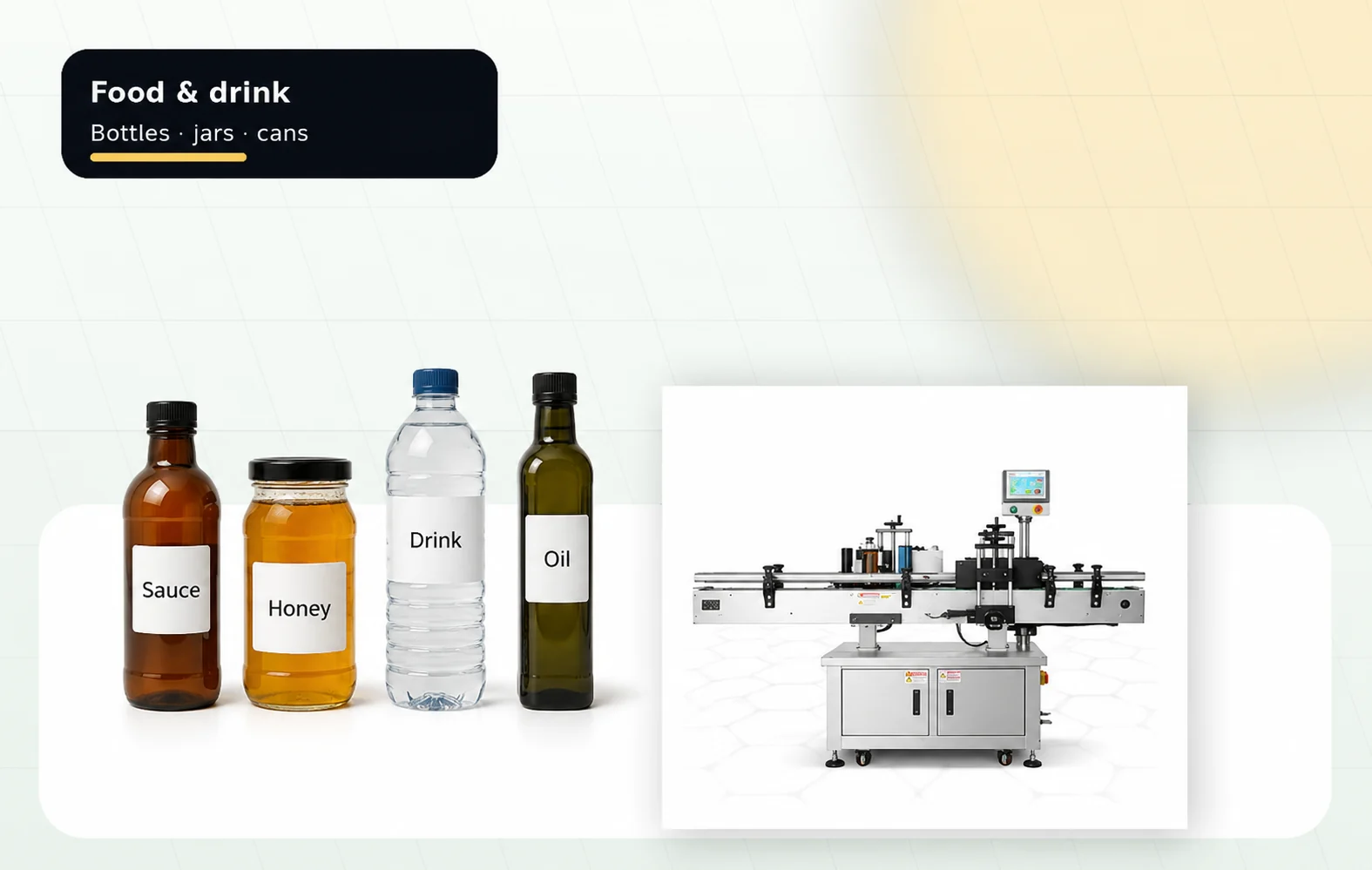
Food and drink manufacturers often label bottles, jars and cans in varied batches. This guide explains what to consider when choosing a wraparound labeller for sauces, honey, oils, drinks and condiments.
Industry guide
Food and drink packs can be glass, PET, tins or jars. Label adhesion, condensation, product residue and batch changeover all affect labelling performance. A reliable setup starts with clean containers and a machine matched to the production pattern.
Check glass or plastic bottle stability and label panel shape.
Review jar diameter, label width and cap clearance.
Consider condensation, bottle material and output speed.
Practical comparison
| Product type | Common container | Labelling consideration |
|---|---|---|
| Sauce | Glass or plastic bottle | Clean sides and stable handling |
| Honey | Round jar or squeezy bottle | Label length and jar diameter |
| Drink | PET or glass bottle | Condensation and high output |
| Oil | Glass or PET bottle | Residue control and adhesion |
| Can | Metal cylindrical can | Consistent wrap and product spacing |
Specification advice
Review the actual container shape, diameter, label panel and surface finish. A label applicator works best when the pack is stable and the label area is predictable.
Confirm label material, roll direction, label gap and adhesive before ordering production labels. Clear, film or metallic labels may need extra testing.
Decide whether the operation is batch-fed, compact automatic or part of a conveyorised filling and capping line. The best machine is the one that fits the full process.
Related guidance
Use these guides to compare machine routes, confirm the label and container specification, and prepare the evidence needed for a useful quotation.
Browse selection, setup, sensing, output, integration and troubleshooting guidance for round-container labelling projects.
Compare bench, compact and automatic routes using container, label, output, changeover and integration requirements.
Collect container dimensions, label-roll data, output, coding and site details before requesting a machine quotation.
Check unwind direction, leading edge and roll presentation before ordering production labels or arranging a trial.
Measure the usable cylindrical panel and estimate label length, seam gap or overlap for a representative sample.
Separate headline cycle rate from sustainable accepted output by allowing for handling, coding, stops and changeovers.
Work through container, roll, sensor, guide and wrap settings when labels skew, wrinkle, bubble or fail to dispense.
Browse selection, setup, sensing, output, integration and troubleshooting guidance for round-container labelling projects.
Review conveyorised wraparound labelling for higher-output round-container lines and upstream or downstream integration.
Review a smaller automatic route for growing production where repeatability is needed without a full-size inline system.
Review operator-fed wraparound labelling for shorter batches, frequent changeovers and limited production space.
Compare bench, semi-automatic, compact and fully automatic wraparound labellers in one range overview.
Questions
Often yes, if the size range and changeover requirements are within the machine capability.
Yes. Oil, sauce or moisture on the label panel can reduce adhesion.
Small batches may suit a semi-automatic or compact automatic labeller depending on output.
Technical review
This guide is maintained by Lancing's packaging machinery team. Lancing states that it has specialised in semi-automatic and fully automatic machinery for over 40 years and supports equipment across the UK, Europe and worldwide. Final recommendations are confirmed against actual containers, labels and production targets.
Last technical review: 11 July 2026 · About Lancing · Official company profile
Quick enquiry
Include container diameter, label size, material, target output and whether the label is paper, film or transparent. Lancing can recommend a suitable semi-automatic, compact or automatic configuration.
Phone: 01494 623015
Email: sales@lancinguk.com
Production-condition testing
The same bottle and label can behave differently when it reaches the labeller cold, warm, wet or with product residue on the surface.
Condensation can affect grip, sensor visibility and label adhesion. Test containers at the temperature and surface condition expected after filling or cooling.
Use safely prepared samples that represent normal surface cleanliness. Check initial tack and edge lift rather than assuming a clean trial bottle is representative.
Keep the label within a cylindrical panel between the lid area and curved base. Check glass variation, moulding seams and the effect of a fitted lid on guides.
Define the required date, batch or lot code and the area available on the production label. Coding may alter web timing or require a stable post-application position, so include it in the output trial. Measure accepted output with normal infeed, finished-pack handling and any downstream accumulation.
Short artisan or seasonal batches may suit the semi-automatic bench route. Regular production can move to the compact automatic route, while continuous filling and capping lines should review the fully automatic labeller. Wider sector machinery is covered by Lancing food and drink production machinery.
Chilled and wet packs
Only when the approved label construction and process have been proven at the actual container temperature and surface condition. Condensation can continue forming after a bottle is wiped, so the trial must reproduce the real delay to application.
Residual water, detergent or mineral deposits can interrupt adhesive contact. Use production-condition containers and define the drying method rather than testing only clean, dry bottles.
Use the final label stock on filled packs and agree the required dwell, chilling, immersion or handling conditions with the label supplier. The machine trial confirms application; the materials evaluation confirms end-use durability.
Use the guide to cold, wet and oily round containers alongside the sample-testing and label-compatibility guides.