
✓
Bottles
For sauce bottles, chemical bottles, drink bottles, cosmetic bottles and healthcare containers where the label wraps cleanly around the body.
Round container labelling
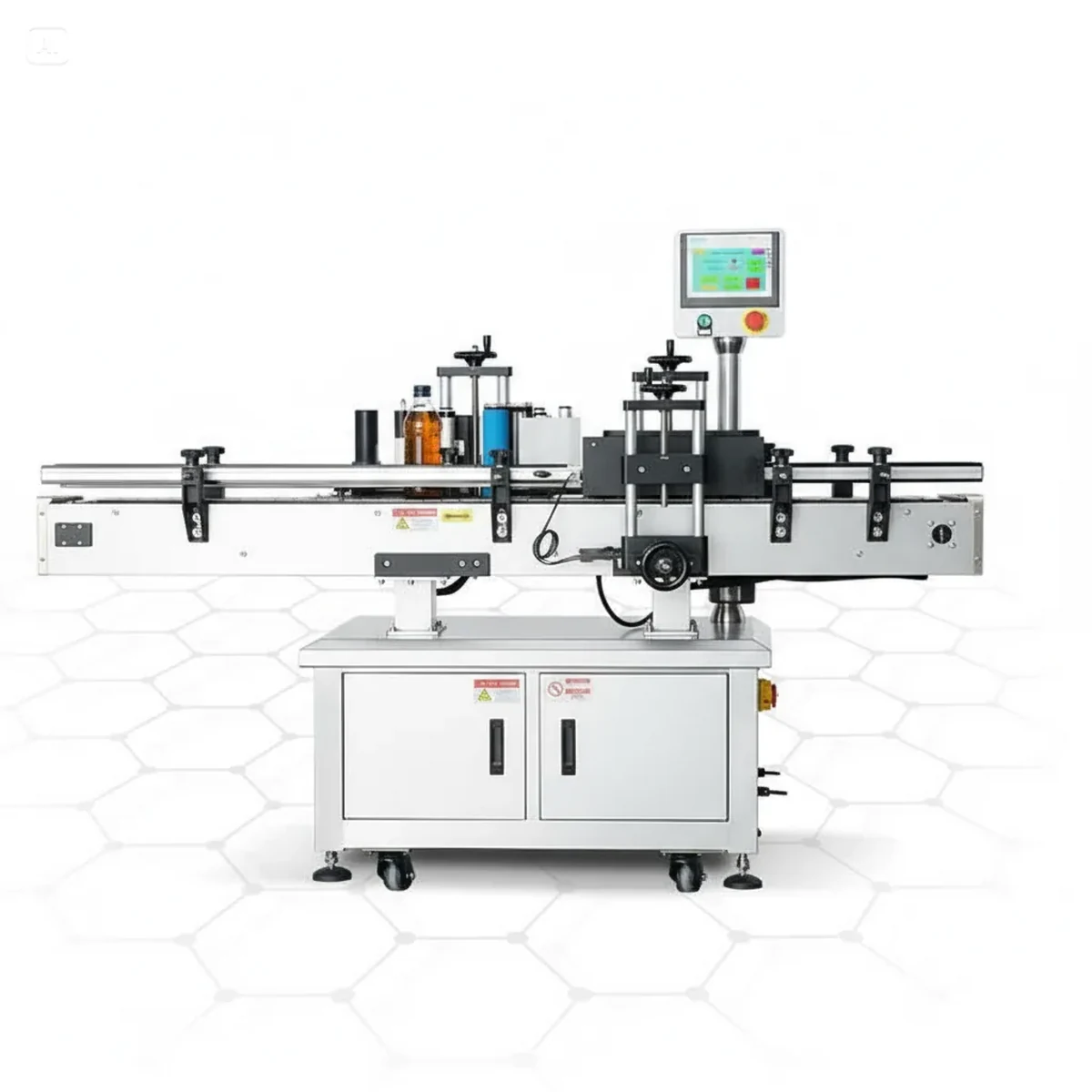
Lancing supplies round bottle labelling machines for cylindrical containers where accurate wraparound label placement, controlled bottle rotation and repeatable changeover are important.
Applications
For sauce bottles, chemical bottles, drink bottles, cosmetic bottles and healthcare containers where the label wraps cleanly around the body.
For honey jars, condiment jars, cosmetic jars and cylindrical retail packs requiring a neat label seam.
For metal cans, plastic tubes and stable cylindrical products that can rotate consistently during application.
Choosing a machine
Best for small batches and operator-fed work where budget and flexibility matter more than speed.
A step up for regular production with conveyor handling and smaller line footprint.
Best where the labeller needs to sit in line with filling, capping, coding and packing equipment.
Questions
It can handle stable cylindrical containers such as bottles, jars, cans, tubes and vials, subject to sample testing and guide setup.
Yes, a clear-label sensor can usually be specified for transparent or film labels.
Yes. Automatic systems can be specified with conveyors, sensors and controls to suit existing filling and capping equipment.
Quick enquiry
Include the container diameter, label size, material, target output and whether the label is paper, film or transparent. We will recommend the most suitable semi-automatic, compact or fully automatic configuration.
Phone: 01494 623015
Email: sales@lancinguk.com
Round-container specification
A bottle can look round while still presenting taper, seams or flexible areas that affect rotation and label alignment.
Measure the diameter and height of every format, then identify the usable straight-sided label panel. The top and bottom of the label should remain on a section that rotates at the same effective diameter. If one edge crosses a shoulder or tapered base, that edge travels a different distance during the wrap and can create skew, wrinkles or an uneven overlap.
Use filled or realistically weighted samples where possible. Product weight, bottle flex, condensation, surface treatments and moulding variation can change grip and stability compared with an empty sample.
Confirm whether the label should leave a gap, meet edge to edge or overlap. Record the acceptable seam area and make sure the label does not bridge a feature that prevents even wipe-down.
Provide the web width, core inside diameter, roll outside diameter, winding direction, gap, backing liner and face material. These details determine whether the roll can be loaded, sensed and dispensed correctly.
| Production need | Route to consider | Why |
|---|---|---|
| Short batches and frequent changes | Semi-automatic bench labeller | Operator-fed handling can be practical when flexibility matters more than line automation. |
| Regular production in limited space | Compact automatic labeller | Automatic sensing and conveying reduce manual handling within a smaller footprint. |
| Continuous filling and capping line | Fully automatic wraparound labeller | Conveyor controls and integration support balanced higher-output operation. |
Round-container wraparound is the ownership focus of this website. If the bottle is oval, rectangular or shaped and requires distinct front and back panels, use Front & Back Labelling Machines UK. For a broader bottle-labelling comparison, visit Bottle Labellers UK.
Round-container quality
Round shape alone does not guarantee stable labelling. Taper, flexible walls, mould variation, roll construction and the container surface can change the result.
Use the diameter and label length guide to identify the usable cylindrical panel.
Use the core and web guide to define the material presented to the machine.
Use the placement-quality guide to agree measurement and seam checks.