
Rotary clamping
Fast infeed and outfeed compared with traditional pneumatic clamping.
Automatic wraparound labelling machines
High-speed wrap-around labelling for round bottles. LUB700-style automatic machines use rotary electric bottle clamping to shorten infeed and outfeed time, supporting up to approximately 6,000 bottles per hour depending on label, container and line conditions.
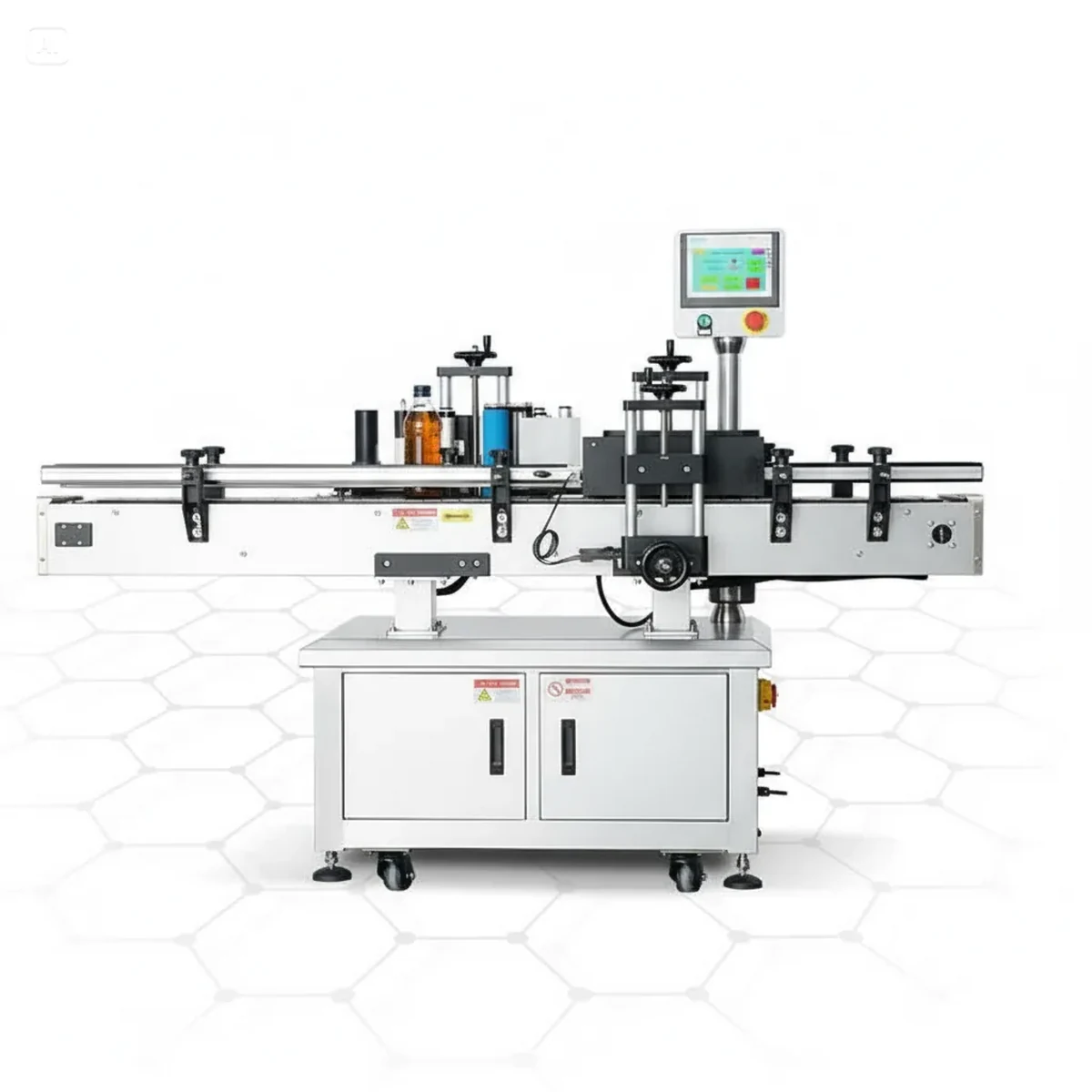
Machine overview
High-speed automatic wrap-around labelling for round bottles, cans and jars, with rotary electric clamping and line integration.
For best results, Lancing reviews your container samples, label roll specification, product handling requirements, and existing line layout before confirming the machine configuration.
Key features
Feature availability varies by model and final configuration. We will confirm all options when quoting your project.
Fast infeed and outfeed compared with traditional pneumatic clamping.
Drive-synchronised dispense supports clean, wrinkle-reduced label application.
Recipe storage helps operators repeat settings during size changeovers.
Transparent-label sensors, code reader and date coder options can be specified.
Encoder and conveyor synchronisation for upstream and downstream equipment.
Rollers, guides and container handling specified around bottle diameter.
Technical specifications
Actual machine dimensions, speed and options are confirmed against the final build and sample tests.
Typical applications
Bottles, jars, cans and retail packs requiring clean front-facing presentation.
Shampoos, lotions, cleaners, sprays, sanitiser and personal care products.
Vials, nutraceutical bottles, OTC packs and industrial cylindrical containers.
Configure your machine
We will review bottle dimensions, label roll, label material, target speed, date-coding needs and line integration before recommending the final build.
Quick enquiry
Include the container diameter, label size, material, target output and whether the label is paper, film or transparent. We will recommend the most suitable semi-automatic, compact or fully automatic configuration.
Phone: 01494 623015
Email: sales@lancinguk.com
Application engineering
The reference automatic route is intended for continuous round-container production, but output and placement quality depend on the complete handling sequence.
Containers first need to arrive at a controlled pitch. A product sensor initiates label dispensing, the leading edge is presented to the container and the pack is rotated through the wrap station so that the label is progressively wiped onto the surface. The selected configuration may use rollers, a belt or a rotary clamping arrangement to control rotation. The container is then discharged at a rate that must remain balanced with upstream filling or capping and downstream coding, inspection or packing.
The automatic reference configuration uses rotary electric bottle clamping, a touchscreen PLC and a synchronised conveyor. Its published output is up to approximately 6,000 bottles per hour, but that figure is label and configuration dependent. A meaningful production target therefore needs the actual container, label length, required gap between products, coding cycle, reject or inspection process and surrounding line conditions.
| Verified reference | Current information | What must be confirmed for the project |
|---|---|---|
| Container type | Round bottles and cans; jars may be reviewed where they rotate consistently. | Minimum and maximum diameter and height, straight label panel, taper, seam, rigidity, base stability and filled weight. |
| Label type | Paper or film; standard or transparent labels with the suitable sensor. | Label width and length, gap, web width, backing, opacity, adhesive, core inside diameter, roll outside diameter and winding direction. |
| Output | Up to approximately 6,000 bottles per hour, label and configuration dependent. | Sustainable normal rate using production containers, coding and the proposed infeed and discharge arrangement. |
| Controls | Touchscreen PLC and synchronised conveyor. | Recipe requirements, line start/stop, fault handshakes, emergency-stop philosophy and any speed-reference signals. |
| Options | Date coder, transparent-label sensor and code-reader options. | Print technology, print area, data source, verification method and reject response. |
| Electrical supply | Typically 220 V, model dependent. | Final supply, site standard, plug or isolation requirements and any pneumatic utilities on the selected build. |
Quality and reliability
A cylindrical, stable pack gives the wrap station a repeatable reference. Taper, moulding seams, flexible walls or an uneven base can change rotational speed and cause the label edge or seam to climb. These features should be identified before the trial.
Face material, stiffness, adhesive, backing liner and static behaviour affect peeling and wipe-down. A transparent label also changes the sensing task. The production label roll should be used for final testing rather than a substitute material.
The labeller cannot sustain a stable rate if containers arrive touching, arrive at irregular intervals or back up at discharge. Infeed spacing, accumulation and downstream availability should be considered with the nominal machine cycle.
For coding on the label, confirm the print area, label material, web movement and required dwell. If a code must be checked after application, the inspection camera or reader also needs a stable view and a defined fault or reject action.
Record settings for product guides, sensor position, label path, wrap pressure and conveyor speed. Representative samples from the smallest and largest formats help establish whether adjustments are sufficient or whether format-specific change parts are required.
Keep the label path, sensors, drive rollers and wrap-contact surfaces clean. Inspect belts or rollers for wear, maintain guide alignment and remove adhesive build-up using methods compatible with the machine and label materials.
Round containers with a genuinely cylindrical label panel are the focus of this machine. Where a pack is flat, oval or shaped and needs separate front and rear labels, use the specialist front and back labelling route instead of forcing the application into a wraparound format.
Trial and quotation
A useful trial should reproduce the production pack, not only demonstrate that one bottle can receive one label.
Provide filled or realistically weighted containers from every critical format, plus a production roll of each label construction. Include drawings or dimensions, the expected roll core and outside diameter, winding direction, normal and peak output, batch length and changeover sequence.
Use the sample-trial guide to define repeat runs, placement measurements and video evidence.
Supply conveyor height and direction, available straight length, upstream speed, product pitch, downstream capacity and controls requirements. The line-integration guide covers spacing, accumulation, start/stop and fault interfaces in more detail.
The official Lancing automatic wraparound reference provides the first-party machine overview.
Buyer questions
Stable round bottles, cans and jars with a usable cylindrical label panel are the normal starting point. Taper, seams, flexible walls and unusual bases should be checked with physical samples.
Transparent labels can be specified with a suitable clear-label sensor. Final compatibility should be tested using the production label, backing liner and gap.
Container pitch, label length, wrap time, coding, inspection, accumulation and the upstream and downstream line all affect sustainable output. The published maximum is label and configuration dependent.
Yes. The automatic route is intended for conveyor integration, subject to review of line height, direction, speeds, accumulation and control signals.
Send representative containers in production condition and a production label roll. Include all critical sizes and materials rather than only the easiest format.
Define the measurement points and allowable variation before the trial. Measure a repeat set at the intended operating rate, including start-up and steady-running samples.
Line acceptance
The LUB700 reference is a conveyorised automatic wraparound route with rotary electric clamping, touchscreen PLC control and options for transparent-label sensing, coding and code reading. Acceptance should cover the complete container journey, not only label dispense.
| Acceptance area | What to agree before the trial | Evidence to retain |
|---|---|---|
| Container presentation | Infeed pitch, guide contact, base support, filled weight, stability and the response to back-pressure or a short interruption. | Video of infeed and recovery, notes on guide settings and a count of any tipped, stalled or double-fed containers. |
| Detection and label start | Container sensor position, label start point and the relationship between product speed, dispense and rotation. | Repeat samples showing the vertical and circumferential label position after start-up and during steady running. |
| Wrap station | Contact surfaces, clamping or wrap pressure, product rotation and treatment of seams, mould marks or flexible walls. | Photographs of the label seam and surface, including any wrinkle, bubble, edge-lift or skew observations. |
| Label sensing | Standard gap or clear-label sensor, label and liner construction, gap size and the proposed production roll. | Count of missed labels, double feeds and false detections across an agreed continuous run. |
| Coding and inspection | Print trigger, data source, print area, code reader, verification logic and the required response to a failed code. | Legibility samples, reader results and confirmation of stop, alarm or reject behaviour where included. |
| Controls and line signals | Normal start and stop, emergency-stop philosophy, upstream and downstream permissives, fault contacts and speed reference where required. | Recorded functional checks and a layout showing interface points, conveyor direction and working height. |
| Accepted output | Container, label length, coding, run duration, permitted stops and quality acceptance criteria. | Accepted labelled containers divided by elapsed running time, with rejects and stoppages reported separately. |
The published automatic reference is up to approximately 6,000 bottles per hour and is label and configuration dependent. A project trial should state the actual container, label dimensions, production roll, sensor, coding, infeed arrangement and run duration. This prevents a short demonstration rate from being mistaken for sustainable line output.
The output speed guide explains accepted-output calculations, while the sample-testing guide provides the wider evidence record.
Provide the available straight length, conveyor height and direction, upstream filler or capper discharge, downstream accumulation and operator access. Confirm label-roll loading space, change-part storage, guarding access and the location of any coder or inspection device. For a complete line review, use the packaging-line integration guide.
Where the requirement is to print and apply a unique variable-data label rather than code a pre-printed wrap label, the specialist print-and-apply range owns that application.
Automatic project evidence
Automatic wraparound labelling depends on controlled infeed, sensing, label-web handling, wrap contact and downstream capacity.
Use the automatic demonstration page to understand the sequence, then trial final containers and production rolls.
Confirm conveyor height, direction, access, utilities and control signals using the installation guide.
Measure label height, skew, seam and wrap quality with the placement-quality method.
Include the most difficult format and a planned stop/restart in the test. Where coding or inspection is included, record the actual data and fault response. Use the changeover guide to confirm the second critical format.
Questions buyers ask
These answers focus on product flow, line behaviour and the operator responsibilities that remain after the labelling cycle is automated.
Yes. An automatic wraparound labeller needs containers to arrive at a repeatable pitch so one product-detection event controls one label cycle. The spacing method depends on bottle diameter, stability and target accepted output. Touching or irregularly spaced bottles can disturb sensing, wrap contact and the seam.
The labeller and upstream supply should respond before back pressure reaches the application zone. The controls strategy must define whether containers accumulate, the labeller pauses, or the upstream machine is inhibited. Containers already between sensors need a known inspection or recovery route after restart.
Plan the sequence in the line integration guide.
It may be possible, but suitability depends on base stability, wall rigidity, centre of gravity, guide contact and conveyor behaviour. A light or partly filled bottle should be tested in the real production condition because an empty sample can rotate or lean differently from the final pack.
Automatic application reduces manual loading, but operators still manage label rolls, format selection, inspections, cleaning, replenishment, coding data, fault recovery and changeovers. The project should define who owns each task and how settings and approved samples are controlled across shifts.
The operator training guide provides a competency framework.
Automatic line questions
An inline labeller must keep each container identifiable and controlled through spacing, sensing, wrapping, inspection and discharge.
The controls need stable product order and a tracking method from inspection to rejection. If bottles queue, slip or change order, the system must still reject the correct pack or stop through an agreed fail-safe response.
It may be possible when the production container has a repeatable, detectable reference and the machine can orient it before application. The reference variation and finished angular relationship must be tested, not assumed.
The exact interface depends on the project, but start permission, ready, run, fault, blocked discharge and emergency-stop ownership should be defined with the upstream and downstream equipment. Avoid relying on operators to bridge an undefined controls boundary.
It can. Camera exposure, code reading, decision time, bottle spacing and reject tracking become part of the complete cycle. Measure accepted output with coding and inspection active under the intended production conditions.
Automatic-line decisions
The answer depends on the required accepted output, container stability, orientation, format range, footprint and connected line. Compare architectures with representative samples and identical test conditions.
Define guarding boundaries, interlocks, emergency-stop response, normal stop behaviour, isolation and safe access across the applicator, conveyors, coding, inspection and reject equipment.
Keep approved recipes, settings, drawings, label specifications, reference packs, maintenance records and verified spare-part identities for the installed configuration.
Read the inline versus rotary guide, safety guide and service and spares guide.