
✓
Small containers
Vials and small bottles need accurate handling and support.
Pharma and healthcare
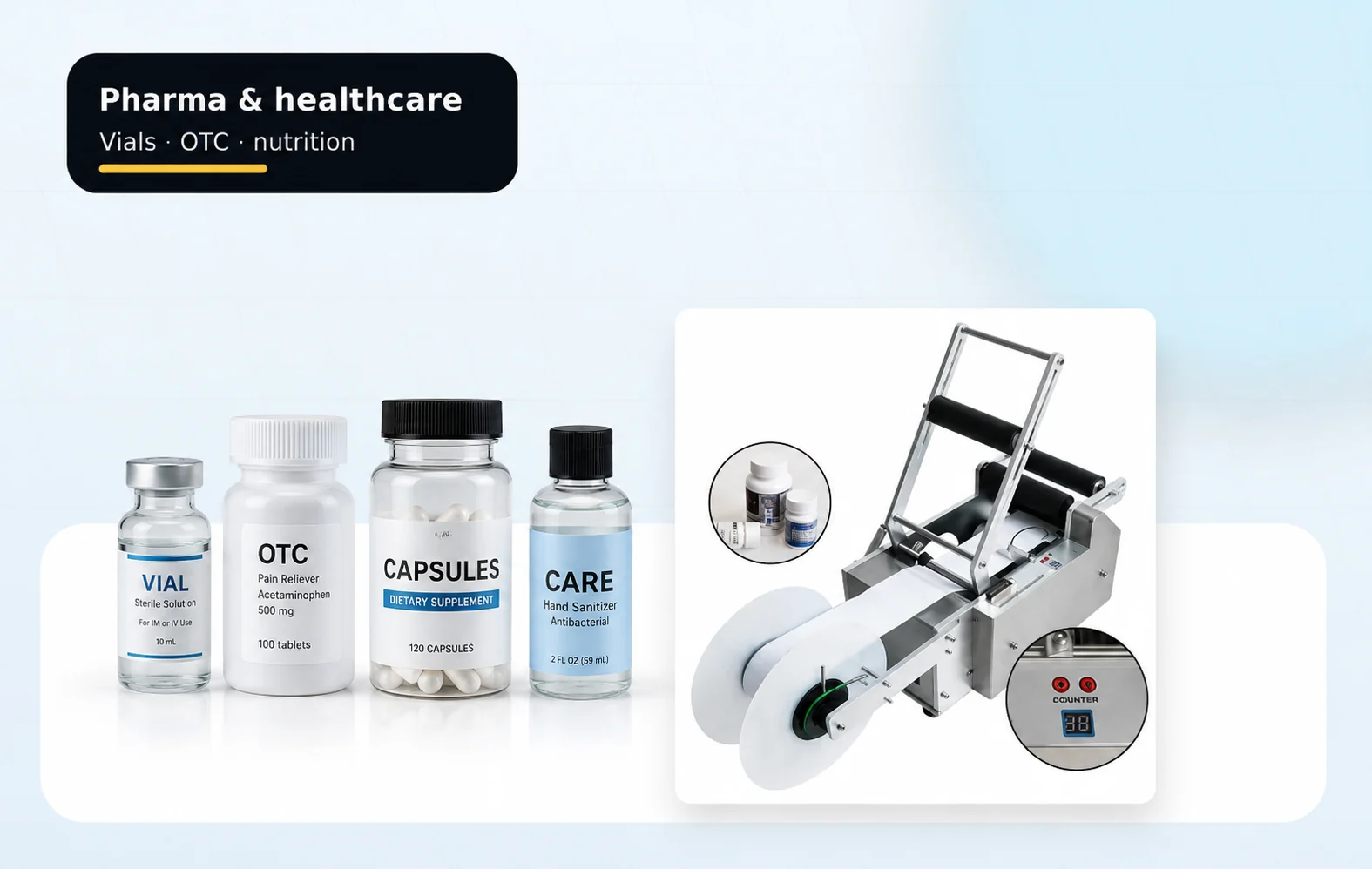
Healthcare and pharmaceutical-style products require accurate, repeatable label placement. This guide covers vials, OTC bottles, supplement containers and small cylindrical products.
Industry guide
Small containers, narrow labels and high information density make labelling accuracy important. The machine should be selected around container stability, label size, batch changeover and any traceability or coding requirements.
Vials and small bottles need accurate handling and support.
Fine text and compliance information benefit from repeatable placement.
Coding and inspection requirements should be considered early.
Practical comparison
| Pack type | Labelling point | Machine consideration |
|---|---|---|
| Vial | Small diameter and height | Precise product support |
| OTC bottle | Round plastic container | Label size and placement |
| Supplement bottle | Wide range of sizes | Changeover and output |
| Sanitiser bottle | Small or medium bottle | Material and residue check |
| Healthcare sample | Small cylindrical pack | Sensor and handling review |
Specification advice
Review the actual container shape, diameter, label panel and surface finish. A label applicator works best when the pack is stable and the label area is predictable.
Confirm label material, roll direction, label gap and adhesive before ordering production labels. Clear, film or metallic labels may need extra testing.
Decide whether the operation is batch-fed, compact automatic or part of a conveyorised filling and capping line. The best machine is the one that fits the full process.
Related guidance
Use these guides to compare machine routes, confirm the label and container specification, and prepare the evidence needed for a useful quotation.
Browse selection, setup, sensing, output, integration and troubleshooting guidance for round-container labelling projects.
Compare bench, compact and automatic routes using container, label, output, changeover and integration requirements.
Collect container dimensions, label-roll data, output, coding and site details before requesting a machine quotation.
Check unwind direction, leading edge and roll presentation before ordering production labels or arranging a trial.
Measure the usable cylindrical panel and estimate label length, seam gap or overlap for a representative sample.
Separate headline cycle rate from sustainable accepted output by allowing for handling, coding, stops and changeovers.
Work through container, roll, sensor, guide and wrap settings when labels skew, wrinkle, bubble or fail to dispense.
Browse selection, setup, sensing, output, integration and troubleshooting guidance for round-container labelling projects.
Review conveyorised wraparound labelling for higher-output round-container lines and upstream or downstream integration.
Review a smaller automatic route for growing production where repeatability is needed without a full-size inline system.
Review operator-fed wraparound labelling for shorter batches, frequent changeovers and limited production space.
Compare bench, semi-automatic, compact and fully automatic wraparound labellers in one range overview.
Questions
Small cylindrical containers can be labelled with suitable handling and label dimensions.
Coding can often be integrated, but code position and line layout should be reviewed.
Send container samples, label material, required placement, batch size and any coding or inspection needs.
Technical review
This guide is maintained by Lancing's packaging machinery team. Lancing states that it has specialised in semi-automatic and fully automatic machinery for over 40 years and supports equipment across the UK, Europe and worldwide. Final recommendations are confirmed against actual containers, labels and production targets.
Last technical review: 11 July 2026 · About Lancing · Official company profile
Quick enquiry
Include container diameter, label size, material, target output and whether the label is paper, film or transparent. Lancing can recommend a suitable semi-automatic, compact or automatic configuration.
Phone: 01494 623015
Email: sales@lancinguk.com
Application boundaries
This guide addresses round-container handling, sensing, placement and coding interfaces; validation and regulatory requirements must be defined for the actual product and market.
Vials and small bottles need stable support, controlled rotation and a label web that can peel cleanly at the required size. Test the minimum container and label, not only a larger demonstration pack.
Define the required data, print area, legibility method and response to a missing or unreadable code. Include any reader or vision step in the line-speed test.
Record the container and label references, sensor, guide settings and accepted sample method so a future material or dimensional change can be assessed against the established application.
Provide representative containers, final label rolls and the intended coding material. Where a transparent label is used, test the exact label and liner with the proposed sensor. Measure label height, skew and seam across a consecutive sample set at the intended operating method.
No statement on this page establishes GMP, cleanroom, validation, serialisation or market compliance for a specific system. Those requirements need a separate user requirement specification, supplier scope and documented acceptance process. Wider sector machinery is covered by Lancing pharmaceutical and medical machinery.