
Automatic labelling architecture
Should a high-output round-container line use an inline or rotary wraparound labeller?
Choose between inline and rotary wraparound labelling by the control needed for the real container and line, not by machine category alone. Accepted output, format range, orientation, changeover, footprint, access and integration all shape the correct automatic route.
- Straight-line and rotary container handling
- Accepted-output and changeover comparison
- Line-layout and trial evidence
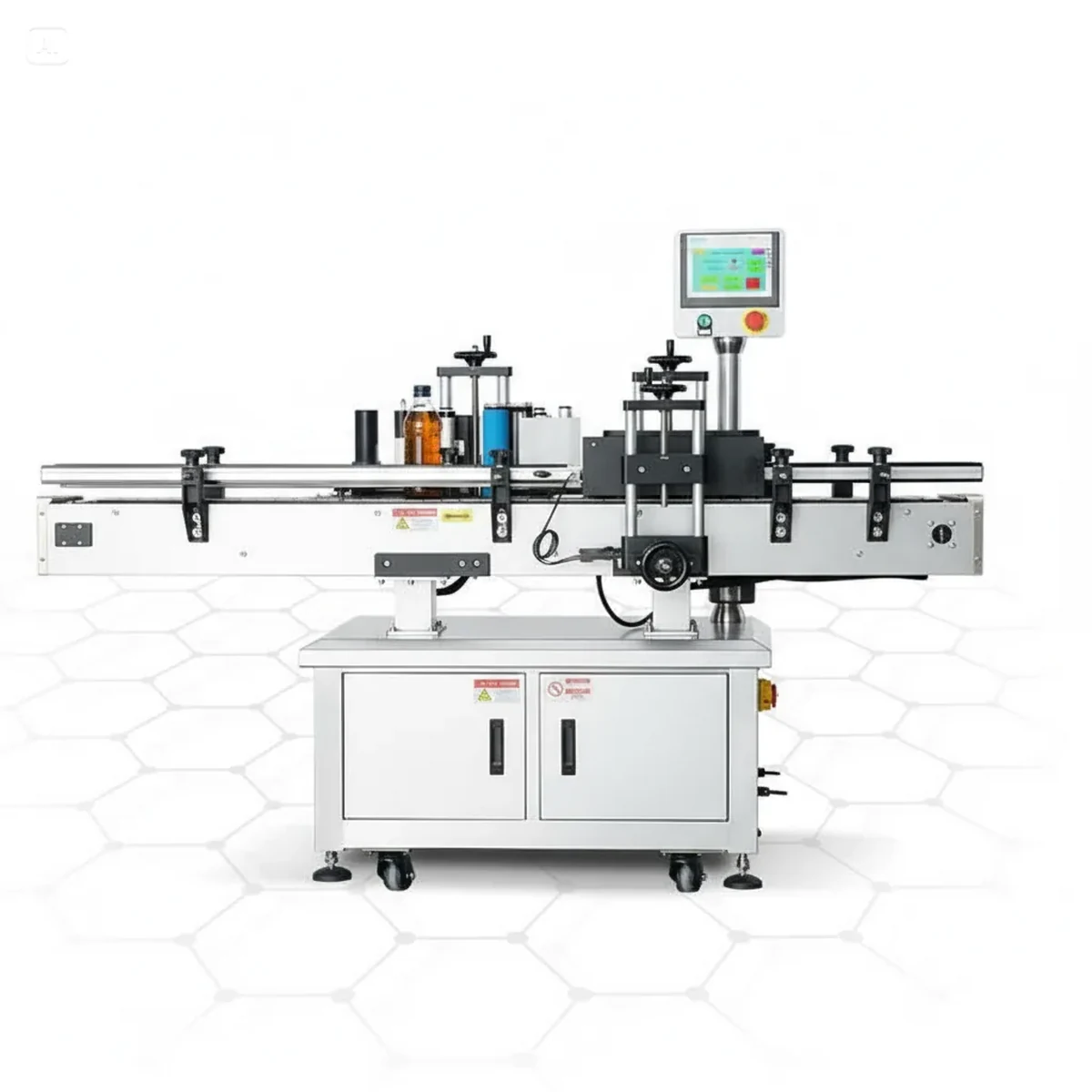
Automatic machine architecture
Compare container control and project complexity, not only headline speed.
Both inline and rotary machines can apply pressure-sensitive wraparound labels to round containers. The right architecture depends on the required accepted output, container stability, orientation, changeover range, available space, connected equipment and acceptance method.
| Decision factor | Inline wraparound labeller | Rotary wraparound labeller |
|---|---|---|
| Product path | Containers travel along a straight conveyor through spacing, dispense and wrap-control devices. | Containers are indexed or carried around a rotating transport system with dedicated positions or handling parts. |
| Container control | Uses guides, spacing devices, belts, rollers or rotary clamping appropriate to the application. | Can provide positive control through star wheels, platforms, heads or format parts, depending on design. |
| Changeover | Can be practical for a wider format range where guide and wrap adjustments are sufficient. | May require more dedicated format parts and a controlled changeover sequence. |
| Footprint and integration | Usually follows the straight conveyor layout and may be easier to place in an existing line. | Requires space for the rotary transport, guarding, access and infeed/outfeed transfer. |
| Output evidence | Should be measured with real spacing, wrap control, coding, inspection and line stops. | Should be measured with the selected format parts, transfer timing, coding, inspection and reject logic. |
Buyer question
What is an inline wraparound labelling machine?
An inline wraparound labeller moves round containers along a straight conveyor and applies the pressure-sensitive label while a belt, roller or controlled clamping arrangement rotates the container. It can operate as a standalone automatic machine or as part of a filling, capping, coding and inspection line.
The exact product-spacing and wrap method should be confirmed against the container. Lightweight, tall, flexible or unstable packs can require more positive control than a rigid, stable bottle.
Rotary architecture
What is a rotary wraparound labeller?
A rotary labeller transfers containers through a rotating handling system with defined positions, often using application-specific stars, platforms, guides or upper control. The architecture can support high control and continuous production, but it adds format-part, transfer, guarding, maintenance and footprint considerations.
Rotary should not be treated as automatically better or faster for every application. The complete machine and line must be quoted and tested against the real container, label and accepted-output requirement.
Output
Is a rotary labeller always faster than an inline labeller?
No machine category has a universally valid speed advantage without defined test conditions. Sustainable accepted output depends on label length, dispense rate, container spacing, stability, transfer, coding, inspection, rejects, roll changes, upstream supply and downstream availability.
Compare quotations using accepted packs per hour under the same run conditions. The output-speed guide explains why a headline application rate is not the same as a stable production result.
Format range
Which architecture suits frequent container changeovers?
An inline route can be simpler where the format range is broad and the containers can be controlled with adjustable guides and wrap devices, while a rotary machine may use more dedicated handling parts. The actual changeover burden depends on the machine design, number of formats, recipe control, tooling weight, access and verification process.
- List every container diameter, height, weight and closure.
- Identify which formats need orientation or upper control.
- Record all format parts and adjustment points.
- Time the complete changeover, including label roll, sensor, coder and quality approval.
- Confirm storage and identification for removed format parts.
Selection sequence
Build the decision from the difficult container and real line conditions.
- Define accepted output. Include normal stops, roll changes, coding and inspection.
- Identify the most difficult format. Use the least stable, highest, lightest, most tapered or orientation-sensitive pack.
- Map the line. Record conveyor height, direction, straight length, accumulation, controls and reject position.
- Define changeover. State the format count, frequency, permitted time and verification steps.
- Run representative trials. Use production containers and labels, then measure placement, rejects and restart behaviour.
Use the automatic wraparound labeller page, line-integration guide and FAT guide to prepare the project data. Lancing will confirm which automatic configuration is available and suitable for the application.
Quick enquiry
Send us your labelling requirement.
Include container diameter, label size, material, target output and whether the label is paper, film or transparent. Lancing can recommend a suitable semi-automatic, compact or automatic configuration.
Phone: 01494 623015
Email: sales@lancinguk.com