
✓
BPM target
Define the required containers per minute for normal production, not just peak demand.
Output speed
Output speed is not just the maximum bottles per minute. Real throughput depends on container handling, label length, changeover, operator loading, coding and the speed of the filling and capping process.
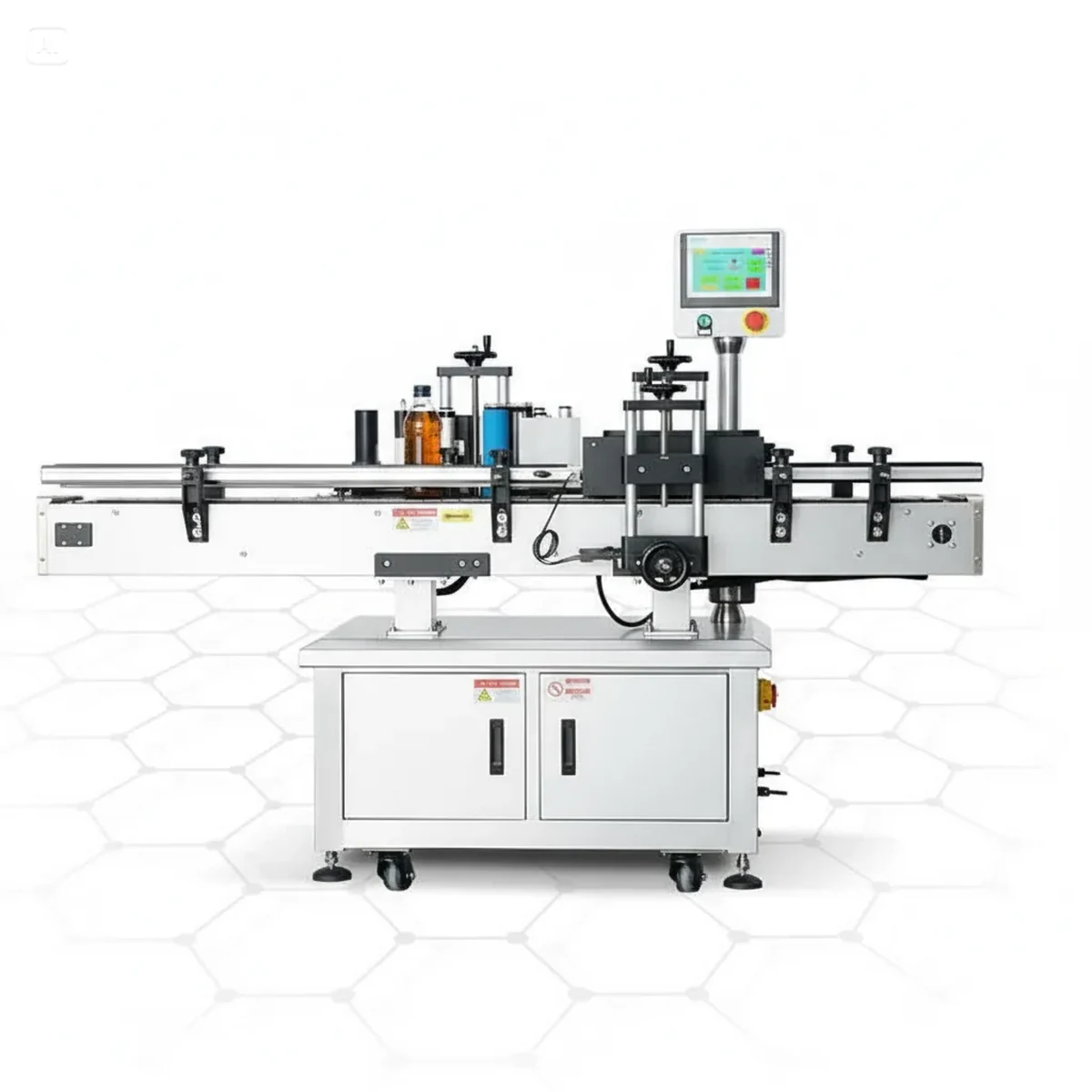
Throughput guide
A machine should be specified around the production requirement, not just its headline speed. A semi-automatic labeller may be efficient for small batches, while an inline automatic machine may be needed where the line must run continuously with limited manual handling.
Define the required containers per minute for normal production, not just peak demand.
Short batches may value fast changeover more than top-line speed.
The labeller should match filler, capper, coder and packing speeds.
Practical comparison
| Production situation | Likely machine type | Reason |
|---|---|---|
| Small batches | Semi-automatic labeller | Lower cost, operator-fed, flexible changeover |
| Growing production | Compact automatic labeller | Automates label application without a large footprint |
| Continuous line | Fully automatic labeller | Conveyorised handling and repeatable throughput |
| Multiple SKUs | Adjustable machine with quick changeover | Reduces downtime between products |
Specification advice
Review the actual container shape, diameter, label panel and surface finish. A label applicator works best when the pack is stable and the label area is predictable.
Confirm label material, roll direction, label gap and adhesive before ordering production labels. Clear, film or metallic labels may need extra testing.
Decide whether the operation is batch-fed, compact automatic or part of a conveyorised filling and capping line. The best machine is the one that fits the full process.
Related guidance
Use these guides to compare machine routes, confirm the label and container specification, and prepare the evidence needed for a useful quotation.
Browse selection, setup, sensing, output, integration and troubleshooting guidance for round-container labelling projects.
Compare bench, compact and automatic routes using container, label, output, changeover and integration requirements.
Collect container dimensions, label-roll data, output, coding and site details before requesting a machine quotation.
Check unwind direction, leading edge and roll presentation before ordering production labels or arranging a trial.
Measure the usable cylindrical panel and estimate label length, seam gap or overlap for a representative sample.
Work through container, roll, sensor, guide and wrap settings when labels skew, wrinkle, bubble or fail to dispense.
Browse selection, setup, sensing, output, integration and troubleshooting guidance for round-container labelling projects.
Review conveyorised wraparound labelling for higher-output round-container lines and upstream or downstream integration.
Review a smaller automatic route for growing production where repeatability is needed without a full-size inline system.
Review operator-fed wraparound labelling for shorter batches, frequent changeovers and limited production space.
Compare bench, semi-automatic, compact and fully automatic wraparound labellers in one range overview.
Send the container, label, output, coding and line details needed for a practical Lancing application review.
Questions
It is the number of containers labelled per minute under suitable conditions, but real output depends on product handling and setup.
Allowing for growth can be useful, but unnecessary speed can add cost and complexity.
Some machines can support future line integration, but this should be considered when specifying the machine.
Technical review
This guide is maintained by Lancing's packaging machinery team. Lancing states that it has specialised in semi-automatic and fully automatic machinery for over 40 years and supports equipment across the UK, Europe and worldwide. Final recommendations are confirmed against actual containers, labels and production targets.
Last technical review: 11 July 2026 · About Lancing · Official company profile
Quick enquiry
Include container diameter, label size, material, target output and whether the label is paper, film or transparent. Lancing can recommend a suitable semi-automatic, compact or automatic configuration.
Phone: 01494 623015
Email: sales@lancinguk.com
Output verification
A valid speed result identifies the container, label, coding, run length, operator method and surrounding line conditions.
The automatic reference can support up to approximately 6,000 bottles per hour when the label and configuration are suitable. The LT-50D semi-automatic reference is approximately 25–50 containers per minute and is explicitly operator dependent. These figures describe different handling methods and cannot be compared without the test conditions.
| Test factor | What to record | Why it changes output |
|---|---|---|
| Container | Diameter, height, filled weight, rigidity and stability. | Handling and rotation time can change with size, slip and guide pressure. |
| Label | Width, length, material, gap and roll condition. | Longer labels and difficult web materials can increase dispense or wrap time. |
| Coding and inspection | Print method, data, verification and reject action. | The coder or reader may become the slowest operation or require extra spacing. |
| Infeed and discharge | Product pitch, accumulation, downstream capacity and stoppages. | An automatic labeller cannot sustain output if containers arrive irregularly or cannot leave. |
| Operator cycle | Load, activate, remove and place finished pack. | Manual handling is part of the semi-automatic cycle and varies by pack and workstation. |
| Run duration | Warm-up, steady-running time, number of stops and changeovers. | A longer run reveals roll changes, replenishment, accumulation and recovery after stops. |
For a steady automatic run, divide the number of accepted labelled containers by the elapsed running time and state any excluded planned stop. For a semi-automatic process, time the complete operator cycle across a representative sample and include normal removal and placement. Report accepted output, not total cycles, if labels or codes are rejected.
Test the normal production format and the format expected to be slowest. A long label on a large container may govern wrap time, while a small unstable vial may govern handling. If multiple stock-keeping units are used, include changeover and setting verification in the daily capacity calculation.
The sample-testing guide provides an evidence record, and the integration guide covers line balance and accumulation.
Shift capacity
A useful capacity figure includes productive time, changeovers, label-roll changes, planned checks, minor stops, rejects and the labour needed to keep the process supplied.
Start with two separate calculations. Productive minutes are the scheduled minutes minus planned changeovers, replenishment, cleaning, checks and recorded stops. Accepted output is the measured running rate multiplied by productive minutes, less rejected or reworked containers. Keep the source data visible so a buyer can see whether an improvement comes from faster application, fewer stops, quicker changeover or better quality.
| Capacity loss | What to measure | Why the record is useful |
|---|---|---|
| Format change | Time from the last accepted pack of one format to the first accepted pack of the next. | Shows whether frequent stock-keeping-unit changes outweigh the benefit of a higher nominal machine speed. |
| Label-roll replenishment | Stop time, roll loading, web threading, sensor confirmation and the first accepted label. | Identifies the effect of roll size, access and operator method on daily capacity. |
| Container starvation | Minutes without a correctly spaced container at the infeed. | Separates a labeller limitation from an upstream feeding or line-balance problem. |
| Blocked discharge | Minutes stopped by collection, inspection, packing or downstream accumulation. | Shows whether extra output would simply move the bottleneck further along the line. |
| Sensor or web stop | Missed gaps, double feeds, web tracking corrections and label-break recovery. | Links lost time to the final label construction and roll quality rather than the headline machine specification. |
| Quality rejection | Skew, seam position, wrinkles, bubbles, edge lift, missing label and unreadable code. | Ensures capacity is based on saleable packs, not total cycles. |
| Operator handling | Loading, activation, removal, inspection and placement time for semi-automatic work. | Allows accepted output per labour hour to be compared with compact and fully automatic routes. |
For the LT-50D route, time the complete operator cycle across a representative run and include normal handling. For a compact or fully automatic machine, record container pitch, line stops, coder and inspection behaviour, and accepted output after downstream restrictions. Do not compare a manual burst rate with a steady conveyor rate as though the test conditions were equivalent.
The format with the longest label, least stable container, most difficult sensor construction or most frequent changeover may govern real capacity. Include that format in the trial and use the sample-testing guide to retain the evidence. The integration guide helps separate machine rate from line balance.
Capacity controls
Sustainable accepted output can fall even when the machine cycle is unchanged if format recovery, roll replacement, inspection or fault escalation is inconsistent.
Measure from the agreed start point to the first approved pack using the changeover guide.
For bench equipment, use the training guide to standardise loading, inspection and replenishment.
Use the automatic demonstration as a sequence reference, not as a capacity claim.
Questions buyers ask
These answers separate a nominal machine rate from the accepted packs a production team can actually release after quality, coding and normal interruptions.
A longer label requires more web to be dispensed and usually more container rotation before the wrap is complete. That can increase the time occupied by each application cycle. The effect depends on the machine, container diameter, label material and spacing, so the actual format must be included in any speed comparison.
Review the measurement relationship in the diameter and label-length guide.
Accepted output can be lower because setup losses, roll changes, product gaps, coding, inspections, rejects, minor stops and upstream or downstream constraints are excluded from a simple cycle-rate figure. Capacity planning should use good labelled packs over a defined period and record the losses that occurred.
The acceptance guide provides a run record structure.
Label-roll changes should be treated as planned production time, using the actual roll size, label pitch, change procedure and operator method. Record how often rolls are changed and the time from the last accepted pack before the change to the first accepted pack after restart.
Use the roll guide and changeover guide.
Coding can change sustainable output through print-cycle time, label-web speed, message changes, verification and the response to unreadable codes. A labeller and coder should be tested together using the intended message and label material, with rejected or held packs included in the accepted-output calculation.
See the coding and labelling guide.