
✓
Filling and capping
Ensure containers reach the labeller clean, capped and stable.
Integration guide
Labelling performance depends on the full production line. Filling, capping, coding, inspection and packing all influence how a wraparound labeller should be specified and installed.
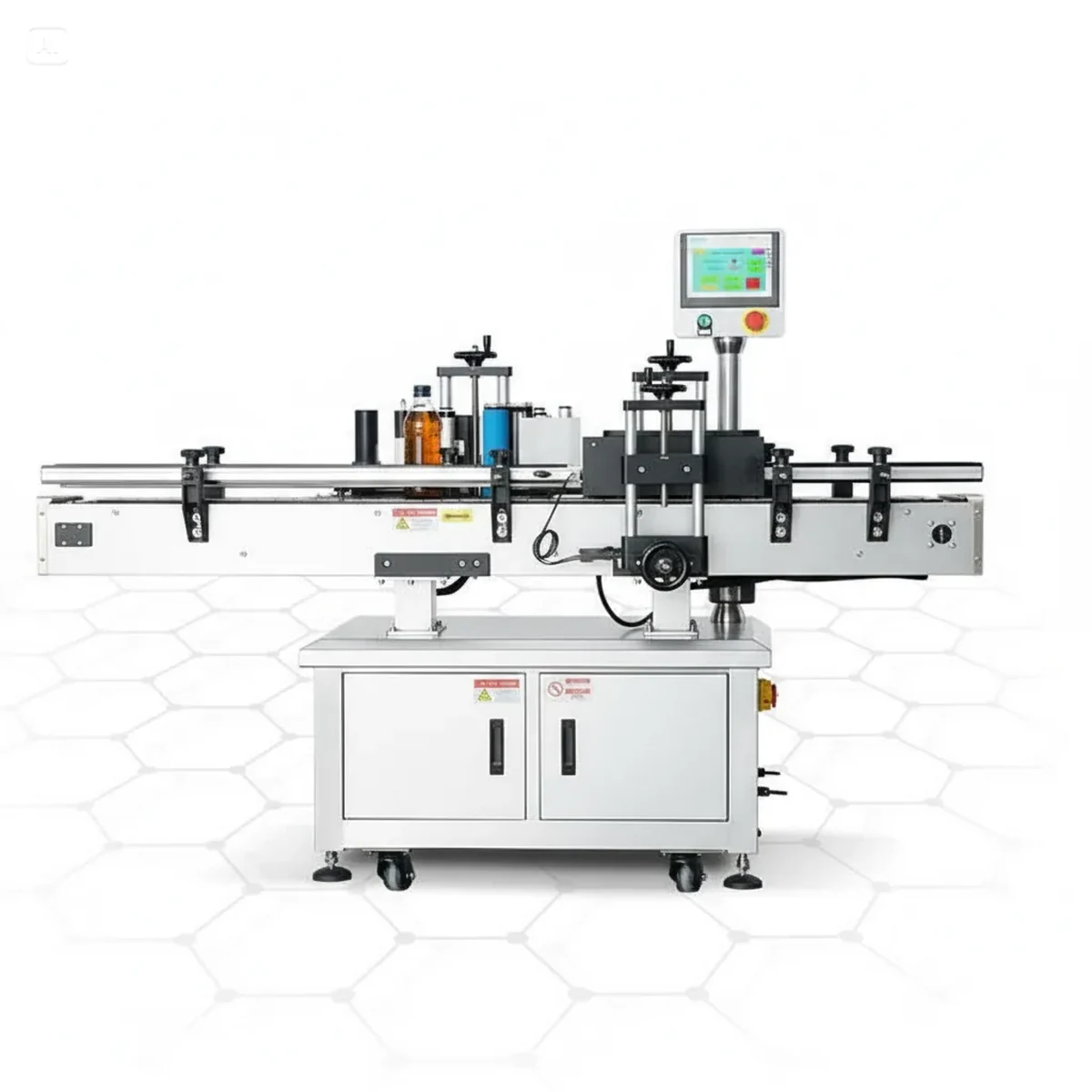
Integration guide
When labelling is part of a complete packaging process, the line should be treated as a system. Product spacing, container stability, line speed, sensor positions and changeover procedures all need to work together. This page explains the practical integration points.
Ensure containers reach the labeller clean, capped and stable.
Allow space and signal coordination for date or batch coding.
Plan outfeed accumulation and manual or automatic packing after labelling.
Practical comparison
| Line element | Integration question | Why it matters |
|---|---|---|
| Filler | Is there product residue on the bottle? | Residue can reduce label adhesion |
| Capper | Is the cap fully applied before labelling? | Unstable caps can affect guides |
| Coder | Where will date coding happen? | Needs space and trigger points |
| Inspection | Is label presence checked? | Can reduce packing errors |
| Packing | How will labelled products leave the line? | Prevents line stoppages |
Specification advice
Review the actual container shape, diameter, label panel and surface finish. A label applicator works best when the pack is stable and the label area is predictable.
Confirm label material, roll direction, label gap and adhesive before ordering production labels. Clear, film or metallic labels may need extra testing.
Decide whether the operation is batch-fed, compact automatic or part of a conveyorised filling and capping line. The best machine is the one that fits the full process.
Related guidance
Use these guides to compare machine routes, confirm the label and container specification, and prepare the evidence needed for a useful quotation.
Browse selection, setup, sensing, output, integration and troubleshooting guidance for round-container labelling projects.
Compare bench, compact and automatic routes using container, label, output, changeover and integration requirements.
Collect container dimensions, label-roll data, output, coding and site details before requesting a machine quotation.
Check unwind direction, leading edge and roll presentation before ordering production labels or arranging a trial.
Measure the usable cylindrical panel and estimate label length, seam gap or overlap for a representative sample.
Separate headline cycle rate from sustainable accepted output by allowing for handling, coding, stops and changeovers.
Work through container, roll, sensor, guide and wrap settings when labels skew, wrinkle, bubble or fail to dispense.
Browse selection, setup, sensing, output, integration and troubleshooting guidance for round-container labelling projects.
Review conveyorised wraparound labelling for higher-output round-container lines and upstream or downstream integration.
Review a smaller automatic route for growing production where repeatability is needed without a full-size inline system.
Review operator-fed wraparound labelling for shorter batches, frequent changeovers and limited production space.
Compare bench, semi-automatic, compact and fully automatic wraparound labellers in one range overview.
Questions
Yes. Lancing can review filling, capping, labelling and packaging line requirements together.
It depends on the pack and code position. This should be reviewed during specification.
Poor product spacing, unstable containers, manual outfeed delays and mismatched line speeds are common causes.
Technical review
This guide is maintained by Lancing's packaging machinery team. Lancing states that it has specialised in semi-automatic and fully automatic machinery for over 40 years and supports equipment across the UK, Europe and worldwide. Final recommendations are confirmed against actual containers, labels and production targets.
Last technical review: 11 July 2026 · About Lancing · Official company profile
Quick enquiry
Include container diameter, label size, material, target output and whether the label is paper, film or transparent. Lancing can recommend a suitable semi-automatic, compact or automatic configuration.
Phone: 01494 623015
Email: sales@lancinguk.com
Line interface definition
Integration succeeds when product transfer, speed balance, accumulation, coding and fault behaviour are treated as one system.
| Interface | Information to confirm | Failure mode if omitted |
|---|---|---|
| Conveyor geometry | Direction, working height, belt width, rail position, available straight length and transfer gaps. | Unstable transfer, insufficient space or a height mismatch between machines. |
| Container presentation | Minimum and maximum pack, pitch, orientation, infeed accumulation and whether containers arrive touching. | Double feeds, missed labels, collisions or inconsistent sensor timing. |
| Speed balance | Normal and peak filler, capper, labeller, coder and packing rates. | Frequent starvation or back-pressure even when each machine meets its individual specification. |
| Controls | Start, stop, ready, run, fault, emergency stop, speed reference and reset philosophy. | Machines continue feeding into a stopped process or cannot recover in a controlled sequence. |
| Coding and inspection | Coder position, print trigger, data source, reader position, reject method and fault response. | Unreadable codes, insufficient product spacing or no defined action after a failed check. |
| Operator access | Label-roll loading, waste removal, cleaning, changeover, guarding access and maintenance clearance. | A technically connected line that is difficult or unsafe to operate and service. |
Short accumulation sections can absorb normal cycle variation, but they do not correct a permanently unbalanced line. State how many containers can queue before and after the labeller, how back-pressure affects the pack and which machine should slow or stop first. Flexible or lightweight containers may need low-pressure accumulation or controlled spacing.
A factory or site trial should include normal start-up, controlled stop, upstream starvation, downstream blockage, label-roll change, format change and recovery from a coding or sensor fault. Record accepted output while all required operations are active. Use production-condition containers and labels so that transfer, sensing and wrap quality are tested together.
The automatic wraparound labeller is the principal round-container route for integrated lines. Broader filling, capping, conveying and packaging-line engineering is owned by Lancing UK.
Installed-line readiness
Controls integration is only one part of line readiness. Access, roll loading, cleaning, changeover and accepted restart behaviour also affect production.
Use the installation guide to confirm access, transfer, supplies and project responsibilities.
Use the changeover guide to capture product, label, sensor and coding settings.
Use the training guide to define routine operation and escalation.
Inspection integration
A failed inspection result is useful only when the correct physical pack is controlled to an agreed response.
Position inspection where the required label or code feature is visible and the container is stable, with enough downstream distance to make a decision and reject the correct pack. Curved reflective surfaces and transparent labels should be assessed with production samples.
The system should confirm that the commanded pack left the accepted product path. The required response to a failed or blocked reject may include an alarm, line stop or controlled hold, depending on the application risk.
Define which machine initiates and resets a stop, how ready and fault states are exchanged and what happens to containers already between stations. Do not leave ownership to informal operator action.
Test good packs, each defined defect, reject confirmation, full-bin or blocked conditions, stop/restart behaviour and recovery after a fault. Record the format, speed and line conditions for every result.
Architecture and safe interfaces
Compare them when accepted output, container control, orientation, format range or transfer stability may justify a different automatic architecture. Use the same containers, labels and line conditions for both assessments.
The required stop response depends on the risk assessment and control design, but connected equipment must not create an unsafe condition when one machine stops. Define the cause-and-effect before commissioning.
Allow safe access for roll loading, cleaning, inspection, format change and maintenance, plus space to remove guards or components where the approved procedure requires it.
Use the inline versus rotary comparison and the safety and PUWER guide.