
✓
Diameter
Measure across the round body where the label will be applied.
Measurement guide
Correct bottle diameter and label length are essential for accurate wraparound labelling. This guide explains what to measure before specifying a bottle labelling machine or ordering labels.
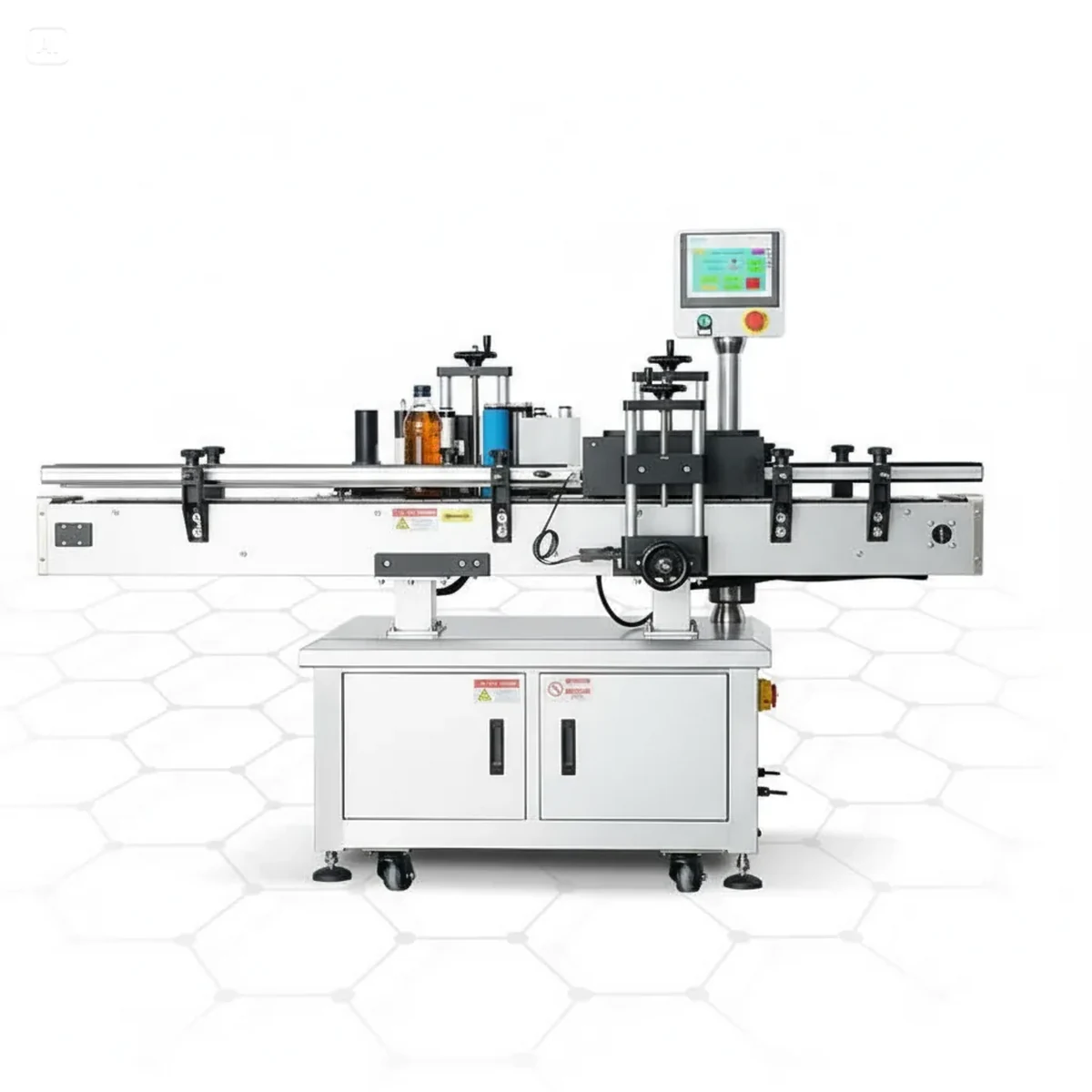
Measurement guide
Wraparound labels depend on the relationship between container diameter, circumference and the length of the label. If the label is too long, overlap may be excessive. If it is too short, the label may look unfinished. If the container is tapered or inconsistent, placement can become more difficult.
Measure across the round body where the label will be applied.
Check that the label area is straight, clean and free from shoulders or heavy taper.
Use diameter to estimate the wrap length and label overlap allowance.
Practical comparison
| Measurement | How to take it | Why it matters |
|---|---|---|
| Container diameter | Use callipers across the label panel | Sets the wraparound rollers and guide rails |
| Label width | Measure top-to-bottom label height | Must fit the available straight label panel |
| Label length | Measure around the bottle direction | Determines overlap and stopping point |
| Taper | Compare top and bottom diameter of label panel | Taper can cause label skewing |
| Surface | Check ridges, seams and texture | Uneven surfaces affect adhesion |
Specification advice
Review the actual container shape, diameter, label panel and surface finish. A label applicator works best when the pack is stable and the label area is predictable.
Confirm label material, roll direction, label gap and adhesive before ordering production labels. Clear, film or metallic labels may need extra testing.
Decide whether the operation is batch-fed, compact automatic or part of a conveyorised filling and capping line. The best machine is the one that fits the full process.
Related guidance
Use these guides to compare machine routes, confirm the label and container specification, and prepare the evidence needed for a useful quotation.
Browse selection, setup, sensing, output, integration and troubleshooting guidance for round-container labelling projects.
Compare bench, compact and automatic routes using container, label, output, changeover and integration requirements.
Collect container dimensions, label-roll data, output, coding and site details before requesting a machine quotation.
Check unwind direction, leading edge and roll presentation before ordering production labels or arranging a trial.
Separate headline cycle rate from sustainable accepted output by allowing for handling, coding, stops and changeovers.
Work through container, roll, sensor, guide and wrap settings when labels skew, wrinkle, bubble or fail to dispense.
Browse selection, setup, sensing, output, integration and troubleshooting guidance for round-container labelling projects.
Review conveyorised wraparound labelling for higher-output round-container lines and upstream or downstream integration.
Review a smaller automatic route for growing production where repeatability is needed without a full-size inline system.
Review operator-fed wraparound labelling for shorter batches, frequent changeovers and limited production space.
Compare bench, semi-automatic, compact and fully automatic wraparound labellers in one range overview.
Send the container, label, output, coding and line details needed for a practical Lancing application review.
Questions
Yes, but changeover range depends on the machine design and the size difference between products.
Overlap depends on label design and container, so artwork should be reviewed against the container circumference.
Some tapered containers can be labelled, but they need review because taper can cause skew or creasing.
Technical review
This guide is maintained by Lancing's packaging machinery team. Lancing states that it has specialised in semi-automatic and fully automatic machinery for over 40 years and supports equipment across the UK, Europe and worldwide. Final recommendations are confirmed against actual containers, labels and production targets.
Last technical review: 11 July 2026 · About Lancing · Official company profile
Quick enquiry
Include container diameter, label size, material, target output and whether the label is paper, film or transparent. Lancing can recommend a suitable semi-automatic, compact or automatic configuration.
Phone: 01494 623015
Email: sales@lancinguk.com
Measurement method
Circumference is a starting calculation; taper, seam requirements, label material and manufacturing variation still need physical confirmation.
For a genuinely cylindrical label panel, the nominal circumference is calculated as π × diameter. A 100 mm diameter therefore has a nominal circumference of about 314 mm. The production label length is then selected according to the required seam: it may leave a deliberate gap, meet with a controlled space or provide an overlap. Do not add a generic allowance without defining the finished appearance and testing it on real containers.
Take diameter readings at the top, centre and bottom of the intended label area and rotate the container to check moulding variation. Record the smallest and largest production samples.
State the target gap or overlap and the acceptable variation. Keep critical artwork and mandatory print clear of the seam area where possible.
Paper, flexible film and stiff constructions can wrap and recover differently. Use the intended adhesive, liner and container surface during the trial.
If the top and bottom diameter differ, the panel is tapered. A rectangular label wrapping around a taper tends to climb or descend because its edges travel different circumferences. Reducing label height, moving the label panel or using a label shape designed for the pack may be necessary; machine adjustment alone cannot remove every geometric limitation.
Provide the diameter and height range, label width and proposed length, gap or overlap, roll information and several physical samples. Use the sample-testing guide to measure skew and seam variation before the label artwork or machine configuration is fixed.
Supply the bottle and label together, including the required gap or overlap and any print-position requirement. Small diameters can make product support and label presentation especially important. Trial the intended container range and agree acceptable position, skew and finish using production-intent label materials.
Related guidance: Small business bottle labeller · Automatic bottle label applicator