
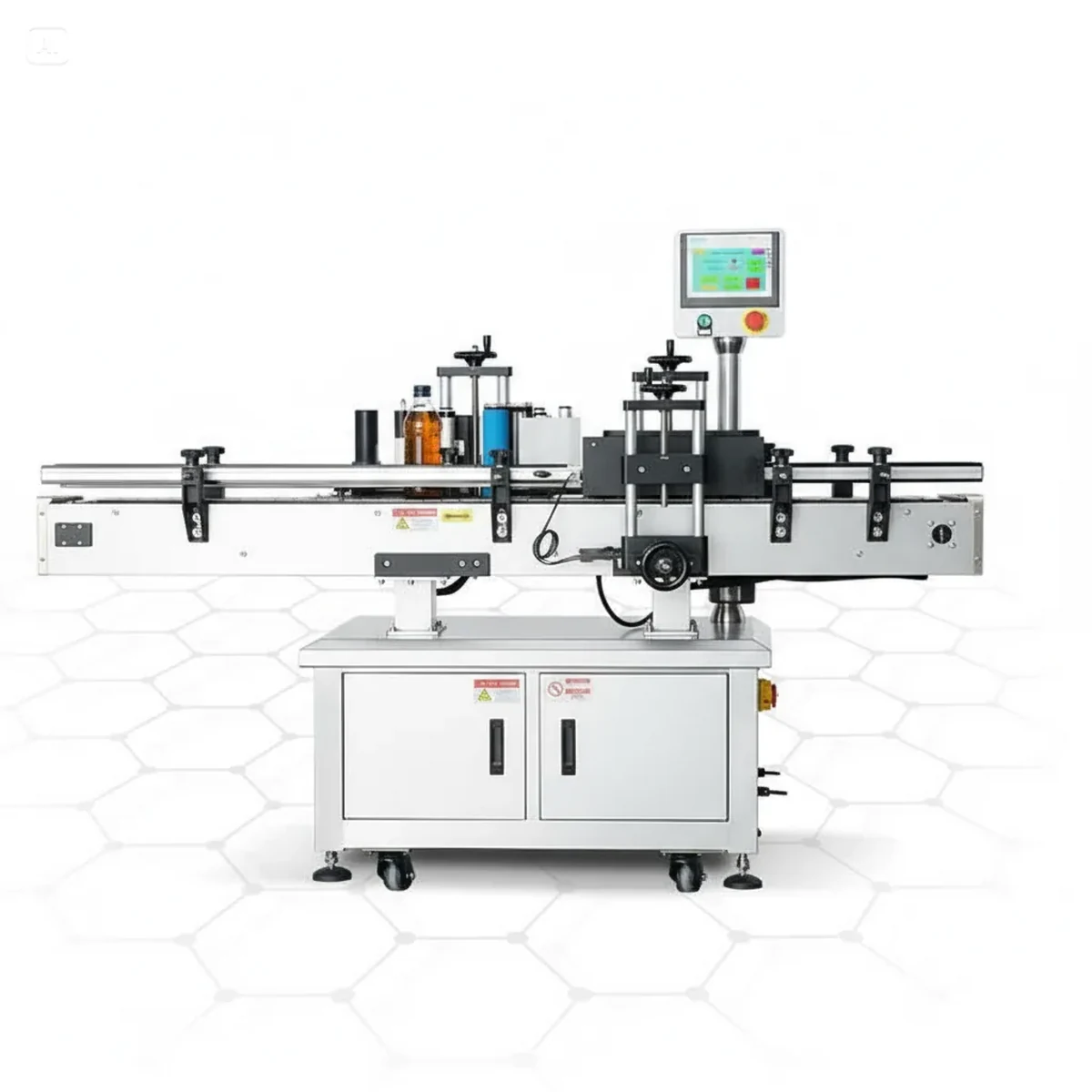
Automatic labelling video

Automatic wraparound labeller demonstration

This short run video shows round containers moving through an automatic labelling station. It illustrates product handling and sequence; it does not by itself establish production output or acceptance.

  • Visible conveyor and container handling
  • What to inspect during an automatic trial
  • Links to machine specification and acceptance guidance
Automatic wraparound labeller demonstration

Run video

Watch the container move through the labelling station.

The demonstration is intentionally short. Use it to understand the sequence, then confirm the application with the actual container, production label roll and agreed test conditions.

Automatic wraparound application

Round containers through the automatic station

The frames show containers presented to the labelling area and moving onward under conveyor control. The clip is visual evidence of sequence only; it is not a timed production test.

What the clip shows

Read the run as a handling sequence.

1

Container presentation

Round containers enter the labelling area under guided conveyor movement. The production project must confirm stable spacing and contact for every format.

2

Detection and dispense

The label cycle is synchronised to container presence and label-web detection. Sensor choice depends on the final paper, film or clear-label construction.

3

Wrap contact

The container is controlled while the pressure-sensitive label is applied around the cylindrical panel. Slip, taper and surface condition affect the result.

4

Discharge

The labelled container leaves the station for downstream inspection, accumulation or packing. Discharge conditions must avoid rubbing or stopping that damages the new label.

5

Quality inspection

Inspect height, skew, seam, bubbles, wrinkles and edge lift using a defined method rather than judging one selected pack.

6

Line evidence

A representative test records accepted output, run length, stops, rejects, coding and the surrounding line conditions.

Trial checklist

Use the video to prepare questions—not to assume performance.

ObserveConfirm during a project trial
Infeed stabilitySmallest, largest, lightest and least stable production containers.
Label sensingFinal production roll, including clear or low-contrast areas and restart behaviour.
Wrap controlFilled weight, surface condition, seam target and repeated placement measurements.
CodingActual data, print area, label material and verification response where required.
OutputAccepted containers over an agreed run with stops and rejects recorded.
ChangeoverSecond critical format, roll replacement and first accepted pack.

See the automatic wraparound labeller for the current verified reference specification, the output speed guide for test conditions and the placement-quality guide for inspection.

What the clip can show

Interpret visible motion separately from verified production capability.

A short demonstration is useful evidence of the labelling principle, but it captures only the material, setup and operating moment shown. Use it to identify the questions that a controlled sample trial must answer.

Visible sequence to review

  1. The container enters the conveyor and approaches the sensing and application area.
  2. The label web is presented through the dispensing path towards the peel point.
  3. The label starts on the rotating cylindrical surface while the container remains controlled.
  4. The wrap arrangement maintains contact as the label travels around the circumference.
  5. The labelled pack leaves the application zone for downstream handling or inspection.

Questions the clip cannot settle alone

  • Whether the most difficult container remains stable over a representative continuous run.
  • Whether every supplied label construction is detected reliably at the intended web condition.
  • Whether placement, seam and coding meet the buyer's measured acceptance limits.
  • How stoppages, restarts, roll changes and upstream or downstream accumulation affect accepted output.
  • Whether the installation needs additional spacing, guiding, coding, inspection or controls integration.

Use production-condition evidence

For a meaningful review, provide filled containers from the size and stability extremes, final label rolls, coding consumables and the intended production sequence. Record accepted packs rather than machine cycles, and state the run duration, operating conditions, interruptions and inspection method. The resulting evidence can then support the installation plan and a format-specific quotation without treating the short video as an unsupported speed or accuracy claim.

Quick enquiry

Send us your labelling requirement.

Include container diameter, label size, material, target output and whether the label is paper, film or transparent. Lancing can recommend a suitable semi-automatic, compact or automatic configuration.

Phone: 01494 623015
Email: sales@lancinguk.com

Enquiries are sent to sales@lancinguk.com. We normally respond promptly during UK business hours.