
Controlled release
Prevents a solid queue from entering the application zone without a defined pitch.
Inline product handling
An inline wraparound labeller needs each round container to reach the application zone upright, stable and at a repeatable pitch. Bottle spacing, conveyor speed, upstream supply, downstream accumulation and control signals must be considered together so the label cycle is not disrupted by touching, rocking, starved or blocked containers.
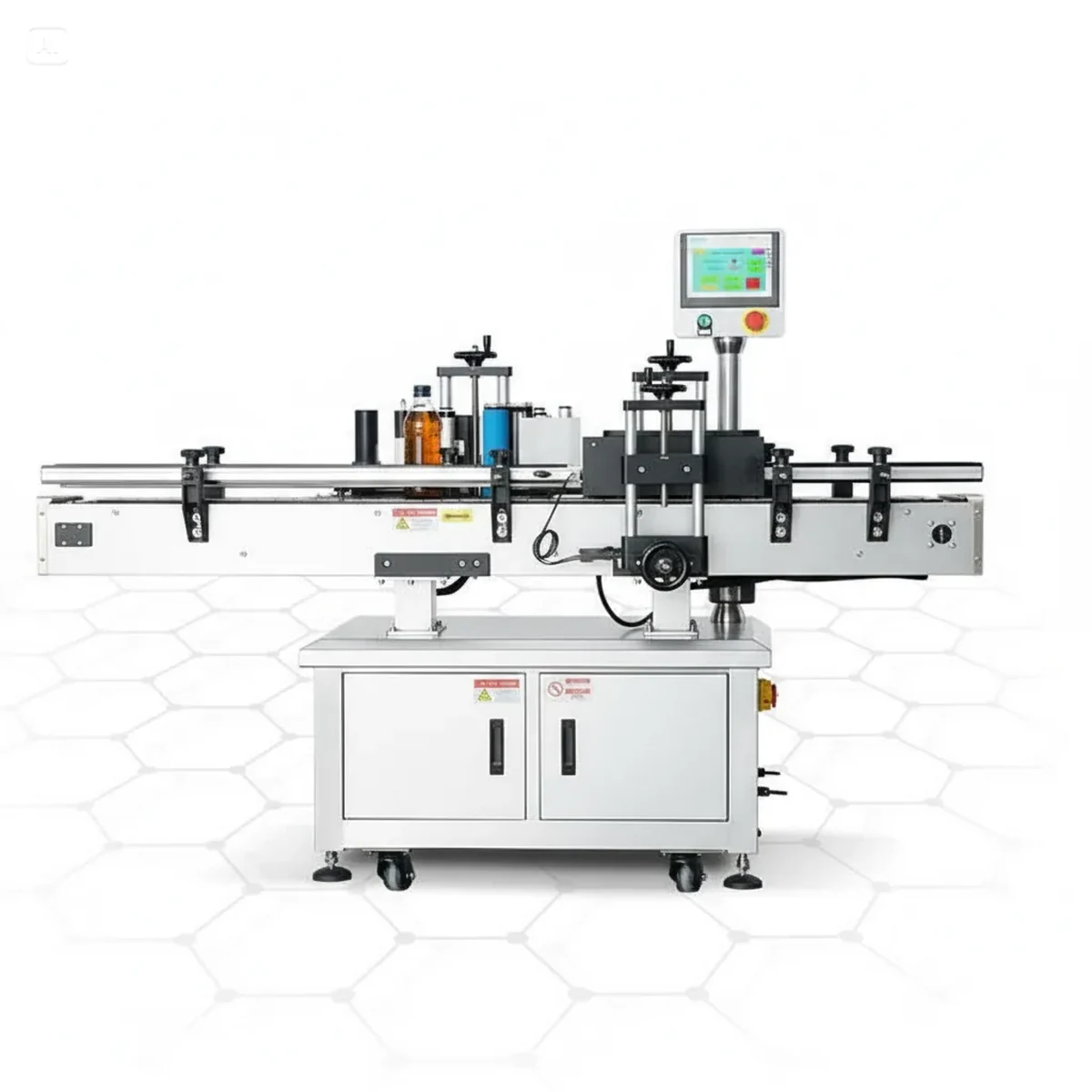
Product flow
The labeller cannot apply consistently if containers collide, lean, rotate before the intended wrap contact or arrive faster than the application zone can accept them.
| Line area | Control objective | Question to answer |
|---|---|---|
| Upstream release | Supply containers without uncontrolled pressure. | How will a filler, capper, turntable or conveyor respond when the labeller slows or stops? |
| Spacing | Create one repeatable product pitch. | Which method suits the container diameter, stability and target accepted output? |
| Application zone | Maintain guide contact and controlled rotation. | Can the pack remain upright without interference from the closure or shoulder? |
| Discharge | Remove labelled containers without rubbing or back pressure. | What happens if inspection or downstream packing blocks? |
| Signals | Coordinate run, ready, fault and stop conditions. | Which machine owns each decision and how are queued containers handled? |
Buyer question
Bottle spacing matters because the labeller needs a defined window to detect one container, dispense one label and control one wrap cycle. Touching or irregularly pitched containers can obscure the product sensor, disturb the wrap contact or cause one label event to overlap the next. The required pitch depends on the container and machine configuration.
Spacing is not simply an empty gap. It is the repeatable relationship between container arrival, product detection, label feed and the available application time. A tall, light bottle may need gentler handling than a short, stable jar even when both share a similar diameter. Use production-condition containers when testing the spacing method.
The process guide explains where spacing fits into the label cycle.
Buyer question
Bottle spacing can be created by controlling upstream release, conveyor speed and a suitable product-separation device. The choice depends on container diameter, rigidity, base stability, closure, line speed and the amount of back pressure. The spacing method should be selected as part of the machine configuration rather than added after poor product flow appears.
Prevents a solid queue from entering the application zone without a defined pitch.
Coordinates the supplying conveyor, spacing action and labeller transport.
Keeps the separated container upright and correctly positioned until wrap contact is established.
Do not assume a spacing method that works for one bottle will suit a lighter, taller or more flexible format.
Buyer question
When the upstream line starves, the labeller should wait without creating false label events. When downstream blocks, the system should stop or control accumulation before labelled containers are damaged or the application zone backs up. The exact response must be defined between machines and tested with containers already in transition.
Map where each container can be when a stop occurs: before detection, during label dispense, in wrap contact and after release. Define whether that container can continue, must be removed, or needs inspection before restart. This prevents duplicate labels, unlabelled packs or unidentified product from passing after a fault.
Use the packaging line integration guide to document the complete sequence.
Buyer question
The project should define the signals or hardwired conditions needed for run permission, machine ready, start, stop, fault and upstream or downstream inhibition. It should also define emergency-stop boundaries, reset responsibility and how coding or inspection faults affect product flow. The actual interface must match the selected equipment and site controls standard.
Final controls and safety interfaces require competent project-specific design and assessment.
Buyer question
Line-control design needs the container range, target accepted output, conveyor direction and height, available straight length, machine positions, accumulation, sensor locations and upstream/downstream operating behaviour. A scaled layout should also show operator access, label-roll loading, rejected-product handling and maintenance space.
The installation guide covers site access and handover information.
Quick enquiry
Include container diameter, label size, material, target output and whether the label is paper, film or transparent. Lancing can recommend a suitable semi-automatic, compact or automatic configuration.
Phone: 01494 623015
Email: sales@lancinguk.com