
✓
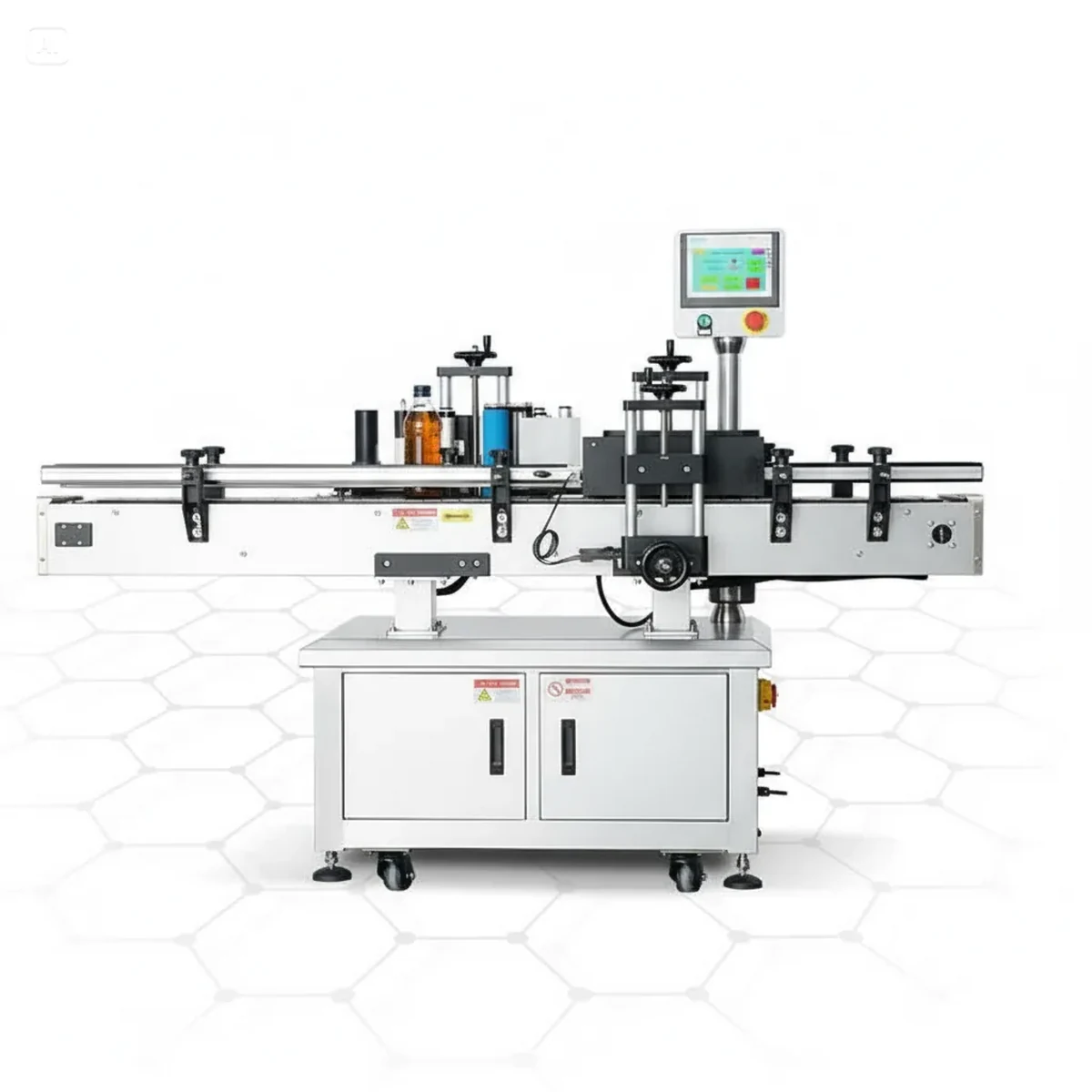
Fully automatic
For conveyorised lines, regular batches and production where manual handling needs to be reduced.
Buyer guide
A wraparound labelling machine is best suited to cylindrical containers where a self-adhesive label is applied around the curve of the bottle, jar, can or tub. This guide helps buyers compare machine styles and prepare the right information before requesting a quote.
Buying guide
The buying decision should start with the container and the label rather than the machine. A stable glass bottle with a short paper label has different requirements from a flexible plastic bottle, a clear film label or a tapered jar. Production speed, changeover frequency, operator involvement and available line space also affect the best choice.
For conveyorised lines, regular batches and production where manual handling needs to be reduced.
For small footprints, moderate output and production teams moving up from manual or semi-automatic labelling.
For operator-fed batches, start-ups, testing, seasonal products and frequent product changeover.
Practical comparison
| Buying factor | What to check | Why it matters |
|---|---|---|
| Container | Diameter, height, shape, material and stability | Controls roller setting, label wipe-down and product handling |
| Label | Width, length, material, adhesive and roll direction | Determines dispense setup, sensor type and label placement |
| Output | Bottles per minute, batch size and shift pattern | Determines whether semi-automatic or automatic is justified |
| Line layout | Conveyor height, infeed, outfeed and coding needs | Affects integration and factory installation |
Specification advice
Review the actual container shape, diameter, label panel and surface finish. A label applicator works best when the pack is stable and the label area is predictable.
Confirm label material, roll direction, label gap and adhesive before ordering production labels. Clear, film or metallic labels may need extra testing.
Decide whether the operation is batch-fed, compact automatic or part of a conveyorised filling and capping line. The best machine is the one that fits the full process.
Related guidance
Use these guides to compare machine routes, confirm the label and container specification, and prepare the evidence needed for a useful quotation.
Browse selection, setup, sensing, output, integration and troubleshooting guidance for round-container labelling projects.
Collect container dimensions, label-roll data, output, coding and site details before requesting a machine quotation.
Check unwind direction, leading edge and roll presentation before ordering production labels or arranging a trial.
Measure the usable cylindrical panel and estimate label length, seam gap or overlap for a representative sample.
Separate headline cycle rate from sustainable accepted output by allowing for handling, coding, stops and changeovers.
Work through container, roll, sensor, guide and wrap settings when labels skew, wrinkle, bubble or fail to dispense.
Browse selection, setup, sensing, output, integration and troubleshooting guidance for round-container labelling projects.
Review conveyorised wraparound labelling for higher-output round-container lines and upstream or downstream integration.
Review a smaller automatic route for growing production where repeatability is needed without a full-size inline system.
Review operator-fed wraparound labelling for shorter batches, frequent changeovers and limited production space.
Compare bench, semi-automatic, compact and fully automatic wraparound labellers in one range overview.
Send the container, label, output, coding and line details needed for a practical Lancing application review.
Questions
Round bottles, jars, cans, vials, tubs and other cylindrical containers are the usual fit.
Not always. Automatic machines suit higher throughput, while semi-automatic machines can be better for small batches and frequent changeover.
Send container diameter, height, label size, label roll direction, material, output target and photos or samples where possible.
Technical review
This guide is maintained by Lancing's packaging machinery team. Lancing states that it has specialised in semi-automatic and fully automatic machinery for over 40 years and supports equipment across the UK, Europe and worldwide. Final recommendations are confirmed against actual containers, labels and production targets.
Last technical review: 11 July 2026 · About Lancing · Official company profile
Quick enquiry
Include container diameter, label size, material, target output and whether the label is paper, film or transparent. Lancing can recommend a suitable semi-automatic, compact or automatic configuration.
Phone: 01494 623015
Email: sales@lancinguk.com
Decision sequence
A robust purchase process narrows the technical risk before comparing price or headline speed.
Check that the intended label sits on a stable cylindrical area. Record taper, seams, shoulders, recessed panels, flexible walls and the required label seam.
List the smallest and largest container and label, plus any clear, film or metallic construction. Include roll core, outside diameter, web width and winding direction.
Use the normal production rate, batch length and changeover pattern. Include manual loading, coding, inspection and downstream handling in the target.
Compare operator-fed semi-automatic, compact automatic and fully integrated conveying against the available labour, space and future growth plan.
Use production-condition containers and final label rolls. Agree measurements and inspect a consecutive run at the intended operating conditions.
Document the tested formats, settings, output conditions, placement method, coding result, utilities and agreed scope before the final quotation.
| Question | Why it matters | Evidence to provide |
|---|---|---|
| Can the container rotate consistently? | Slipping, rocking or walking changes label height and seam position. | Filled samples from the dimensional extremes and photographs of moulding features. |
| Can the sensor detect the label gap? | Transparent or low-contrast materials may not be reliable with a standard gap sensor. | A production roll with the actual label, backing liner and gap. |
| Is the output target a full-line target? | A labeller cannot sustain a rate that the infeed, coder or discharge cannot support. | Normal and peak rate, upstream and downstream equipment, product pitch and accumulation. |
| How will placement be accepted? | “Straight” is subjective unless measurement references and tolerances are agreed. | Defined top/bottom reference, seam target, sample count and test speed. |
| What changes between products? | Changeover time can matter more than top speed for short batches. | Format matrix, batch sizes, change frequency and required recipe or setting records. |
The round-container application belongs on this site. If the pack is flat, oval or shaped and uses distinct front and rear labels, continue to the front and back labelling specialist. For a wider comparison of bottle-labelling methods, use Bottle Labellers UK. Print-and-apply identification for cartons, cases or pallets is a different process and should be reviewed within the wider Lancing labelling range.
From shortlist to acceptance
The machine choice becomes clearer when the quotation, installation, training and acceptance evidence are defined at the same time.
Use the quotation factors guide to compare automation, sensing, coding, integration and project services on the same basis.
Use the installation guide and training guide to identify site responsibilities.
Review the automatic and semi-automatic demonstrations as process examples, then confirm actual output using production-condition samples.
Complete buying decision
Yes. Condensation, oil, dust, chemical exposure, cleaning methods and container temperature can affect label materials, machine construction, sensing, maintenance and trial conditions.
Consider rotary architecture where the required container control, accepted output or transfer method cannot be demonstrated adequately with the proposed inline route. Compare both under equivalent conditions.
Confirm manuals, settings backups, training, maintenance expectations, support contacts and the method for identifying and ordering verified spare parts for the final machine.
Review difficult surface conditions, inline versus rotary labelling and service and spares planning.